受电设备 · 环氧乙烷灭菌
EO sterilization of electronic medical devices is possible, 但这不是一个例行决定. A chamber cycle combines vacuum, 热, 湿度, 密封容器中的 EO 气体和电气风险, and the device brings its own energy source into that environment. This guide sets out what the risk assessment must contain, why batteries, capacitors and switches change the answer, and how the 14-point active-device checklist from the Ethylene Oxide Sterilization Association (EOSA) is read in practice.
Why EO Is Used on Powered Devices
For device developers, EO sterilization of electronic medical devices is attractive for a simple reason: ethylene oxide penetrates narrow lumens, sealed pouches and complex assemblies, and it sterilizes at temperatures that most polymers and electronics tolerate — typically 37–55 °C rather than the 121–134 °C of steam. For a device with a battery, a sealed sensor cavity or an encapsulated PCB, that combination is often the only terminal sterilization method that leaves the product functional.
The same properties that make EO effective also make it demanding. EO is flammable, toxic and reactive; it boils at about 10.7°C and forms a flammable atmosphere across a very wide concentration range in air. A chamber full of gas is therefore an environment where an unexpected spark, a hot component or a venting battery cell is not a minor fault. That is why the assessment below sits upstream of the sterilization cycle, not inside it.
What Makes a Powered Device Different
A passive instrument presents the sterilizer with materials and geometry. A powered device adds stored energy and switching logic, and both can change state during the cycle without anyone touching the device.
- Stored energy. Capacitors hold charge after the device is switched off; a capacitor that is not discharged can deliver a spark when a connector shifts or when humidity bridges a gap.
- Batteries. A cell under vacuum, heat or mechanical stress can vent, rupture or, in the worst case, enter thermal runaway. Lithium chemistries are the usual concern, but alkaline and nickel-metal-hydride cells have their own pressure and electrolyte behaviour.
- Switches and interlocks. A membrane switch or a reed contact can close because of pressure change, condensation or static, starting a device that was shipped off.
- Enclosures. Sealed housings trap air and moisture; the pressure and vacuum steps of the cycle load the seal, the housing and any feed-through in a way that bench testing does not reproduce.
- Motors and actuators. A motor that spins during evacuation becomes a generator, and the back-EMF can appear on connectors that were not designed to carry it.
The Risk and Safety Assessment
Because of the ignition risk, a risk and safety assessment must be completed before EO is selected for a device. It is the device manufacturer’s responsibility; a third-party electrical engineering or failure-analysis consultancy can contribute, but the manufacturer owns the conclusion. The assessment has to answer three questions: can the device be energized during the process, what prevents ignition if it can, and are the battery and the other energy-storage components compatible with EO and with the cycle environment.
| Input | What it must show | Why the assessor needs it |
|---|---|---|
| Instructions for use (IFU) | How the device works and how its energy circuits are completed | Establishes whether the device can become active without user action |
| Product and design details | Battery current and voltage, and circuit diagrams marking voltages, currents, switches, controllers, capacitors, resistors and transformers | Identifies every point where energy can be stored, switched or discharged |
| Proposed sterilization cycle | Complete parameters: 温度, vacuum levels, 湿度, 环氧乙烷浓度, exposure and number of cycles | Shows what environment the device must survive, and how the device may affect the chamber |
| Battery specification | Chemistry, capacity, venting behaviour and temperature limits | Determines compatibility with EO, with vacuum and with the cycle temperature |
The assessment must answer, at minimum, the following questions:
- Can the device be energized during EO processing?
- If it can, are multiple safeguards in place to prevent ignition — for example an interlock switch or a power isolation tab?
- Are the individual battery components compatible with EO?
A complete answer also requires the full parameters of the intended cycle, because the interaction runs in both directions: the cycle acts on the device, and the device can act on the cycle. A battery that vents during vacuum changes the chamber atmosphere; a device that switches on during exposure adds an ignition source to a flammable gas mixture. Neither effect appears in a materials-compatibility table.
The EOSA Checklist for EO Sterilization of Electronic Medical Devices
EOSA publishes an active-device safety review checklist that turns the assessment into a structured review. The table below follows the source document: the checklist item, then a yes/no answer for the reviewer to mark. Items 2, 3, 6, 7, 8–11 和 14 carry stop conditions, listed after the table — the indicated answer means the device must not proceed to EO sterilization until the issue is resolved and the assessment is repeated.
| # | Checklist item | 是的 | 不 |
|---|---|---|---|
| 1 | Are product specifications and/or other design details attached? | ||
| 2 | Does the device draw more than 5 A at 12 V? | ||
| 3 | Does the device store any energy, for example in capacitors? | ||
| 4 | Does the device have an on/off switch? | ||
| 5 | Is there a power isolation tab that prevents the device from switching on automatically? | ||
| 6 | Could the device start during sterilization? | ||
| 7 | Could the device exceed a known safe potential or temperature and ignite EO? | ||
| 8 | After EO injection, is the sterilization cycle non-flammable? | ||
| 9 | Is the sterilization cycle temperature acceptable for the battery? | ||
| 10 | Is the vacuum purging of the sterilization cycle acceptable for the battery? | ||
| 11 | Is the battery chemistry compatible with EO? | ||
| 12 | Is an exothermic test required to confirm battery compatibility? | ||
| 13 | Does the device contain a motor? | ||
| 14 | If so, evaluate the energy that may be generated during sterilization — is it greater than 5 A at 12 V? |
Stop conditions: a “yes” on items 2, 3, 6, 7 或者 14, or a “no” on items 8 到 11, means the device cannot proceed to EO sterilization. Resolve the design issue, document the change, and repeat the assessment before the device is loaded into a chamber.
Reading the Energy Threshold
The 12 V / 5 A reference in items 2 和 14 is not a pass mark for a device; it is the point at which the assessment moves from a checklist to an engineering analysis. Sixty watts at the terminals, switched into an inductive load or discharged from a capacitor, is enough to produce a spark with energy well above the minimum ignition energy of an EO/air mixture, which is in the order of tenths of a millijoule. Below the threshold a device can still fail items 3, 6 或者 7, which is why the checklist is read as a whole rather than as a score.
The same logic explains why vacuum matters. A sealed housing that holds pressure at sea level can be stressed in the opposite direction during evacuation, and a pouch that looks intact on the bench can draw air through a feed-through. If the device contains a cell that vents under reduced pressure, the chamber atmosphere changes during the cycle — the risk is then chemical as well as electrical.
Design Measures That Make a Device EO-Compatible
Most devices can be made compatible, but the fix normally sits in the design or in the sterilization configuration, not in the cycle recipe. The design changes that make EO sterilization of electronic medical devices defensible usually resolve the checklist in one of these ways:
- Remove the battery before sterilization where the IFU permits it, and validate the device’s function after re-fitting. This is the simplest route and removes items 9 到 12 at once.
- Fit a mechanical isolation tab that survives packaging, handling and vacuum, and specify in the IFU that it must remain in place until after aeration.
- Discharge or remove large capacitors, or specify a bleeder resistor sized for the worst-case storage time between manufacture and sterilization.
- Vent sealed enclosures with a membrane or a controlled leak path so that pressure equalizes without drawing contaminated air back in.
- Keep heaters and fuses away from the gas path, and confirm that no surface can reach a temperature capable of igniting EO under fault conditions.
- Test function after exposure, not only before: repeated cycles can change switch feel, display contrast and battery capacity even when nothing ignites.
Residual EO is the other half of the compatibility question. Devices with sealed cavities, elastomer seals and battery compartments desorb slowly, so the aeration time has to be validated against the 国际标准化组织 10993-7 剩余限度 rather than assumed from a passive instrument.
What the Sterilizer Needs From the Device Manufacturer
The contract sterilizer or in-house facility cannot complete this assessment on the manufacturer’s behalf, but it can refuse to load a device without it. A complete submission — the item that turns EO sterilization of electronic medical devices from a request into a qualified process — contains the risk and safety assessment, the completed checklist with evidence for every asterisked answer, the IFU section that describes the sterilization configuration, the cycle parameters the device is qualified for, and the packaging specification.
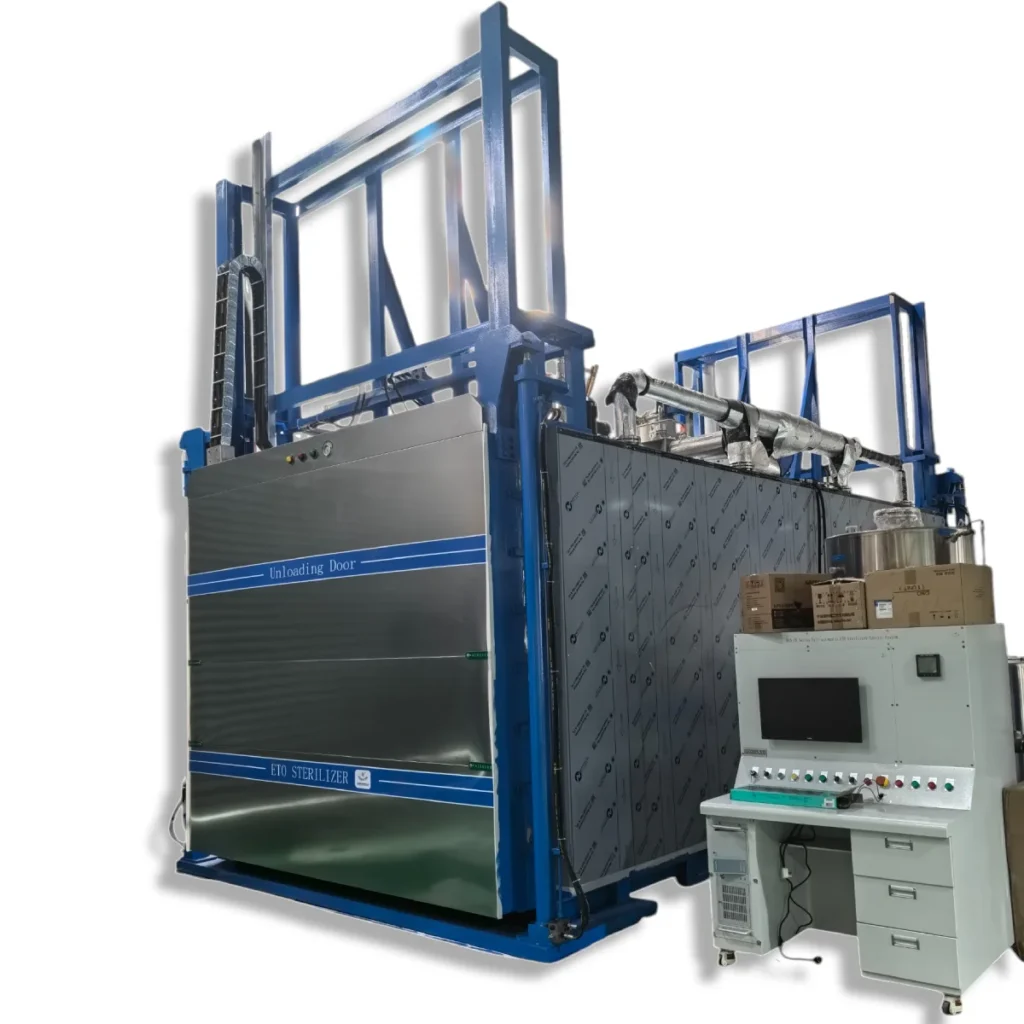
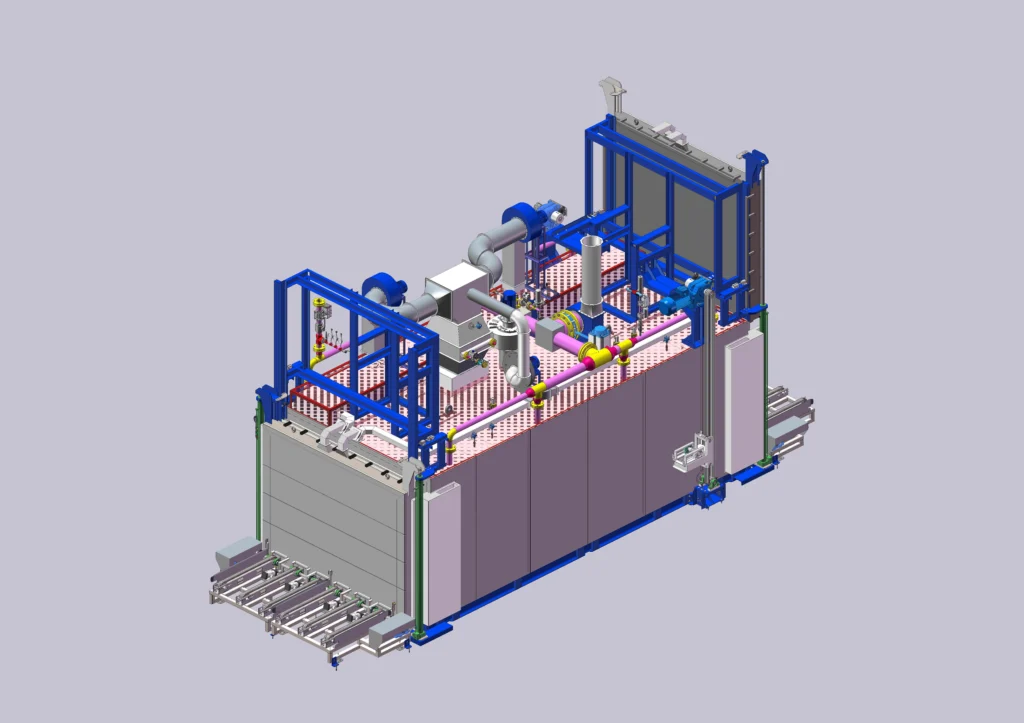
From the sterilization side, the facility confirms that the chamber can deliver those parameters, that the load configuration does not create a new ignition path, and that the cycle has been validated for the product family. The equipment requirement is the same one that applies to any EO load: a leak-tight chamber, calibrated temperature, humidity and pressure channels, and a validated cycle. 这 室泄漏测试 和 industrial EO sterilizer platform are the equipment half of that argument; the device assessment is the other half. Together they are the evidence that EO sterilization of electronic medical devices is a controlled process rather than an assumption.
常见问题解答
Can you EO sterilize a device that contains a lithium battery?
Only after the battery has been assessed against items 9 到 12 of the checklist and, where the chemistry is uncertain, tested for exothermic behaviour. In many programmes the answer is to sterilize without the battery and fit it afterwards under controlled conditions, because that removes the vacuum, temperature and venting risks in one step.
Does EO damage electronics?
EO itself is generally compatible with PCBs, solder joints and common encapsulation materials, and the process runs at temperatures below the limits of most components; the material compatibility question is covered separately in the EO material compatibility guide. For EO sterilization of electronic medical devices the damage risk comes from the cycle environment — 空的, 湿度, repeated thermal cycling and residual gas in sealed cavities — rather than from the gas attacking the circuit.
Who is responsible for the ignition risk assessment?
The device manufacturer. A third-party electrical engineering or failure-analysis consultancy can support the work, and the sterilization facility can review the result, but the manufacturer owns the design knowledge and therefore the conclusion. A sterilizer that accepts a device without that assessment is taking on a risk it cannot evaluate.
What does the 12 V / 5 A threshold mean?
It is the level at which the checklist requires a full engineering analysis rather than a simple answer. Above it, the energy available at the terminals or generated by a motor is large enough that ignition cannot be excluded by inspection, so the assessment must quantify the spark energy against the flammability of the cycle atmosphere.
Is a functional test required after sterilization?
是的. EO compatibility is not only about ignition; the device must still work after exposure and after aeration. Test the functions that the cycle can affect — switches, displays, 传感器, battery capacity and seals — and repeat the test after the maximum number of cycles the device is claimed to withstand.
Sterilizing a Device With a Battery or a Sealed Electronics Bay?
Send the device description, battery specification and intended cycle. Our engineers return a compatibility review, a completed active-device checklist and the cycle parameters the chamber must deliver.
在 WhatsApp 上与工程师聊天 索取技术提案参考: EOSA active-device safety review checklist · 国际标准化组织 11135:2014 · 国际标准化组织 10993-7. Assessment inputs and checklist wording follow the source guidance for devices containing electronic components.