Calificación del proveedor · ISO 11135
Most ETO sterilizer tenders are decided on chamber volume and price, luego entregado por una empresa que no posee ni la plantilla de soldadura ni el software de control. Seven engineering checks separate an ETO sterilizer manufacturer from an integrator before the purchase order is signed.
Key principle: ask who welds the chamber, who writes the recipe editor, and who signs the FAT report. If the answer is three different companies, the validation risk sits with you.
Why the ETO Sterilizer Manufacturer Behind the Chamber Matters
An industrial ETO sterilizer is a pressure vessel wrapped in a control problem. The chamber must hold vacuum and pressure within defined tolerances, the sterilization cycle must deliver a validated combination of temperature, humedad, EO concentration, and exposure time, and the records must survive an audit years later. Each of those capabilities lives in a different department — fabrication, software, validation — and a trading company can only subcontract all three.
That structure is workable until something changes: a new product family, a failed biological indicator, a regulatory inspection that asks for the original design calculation. At that point the buyer needs the organisation that designed the vessel and wrote the controller, not an intermediary forwarding emails. The checks below are written to surface that distinction early.
Controlar 1: Who Actually Fabricates the Chamber?
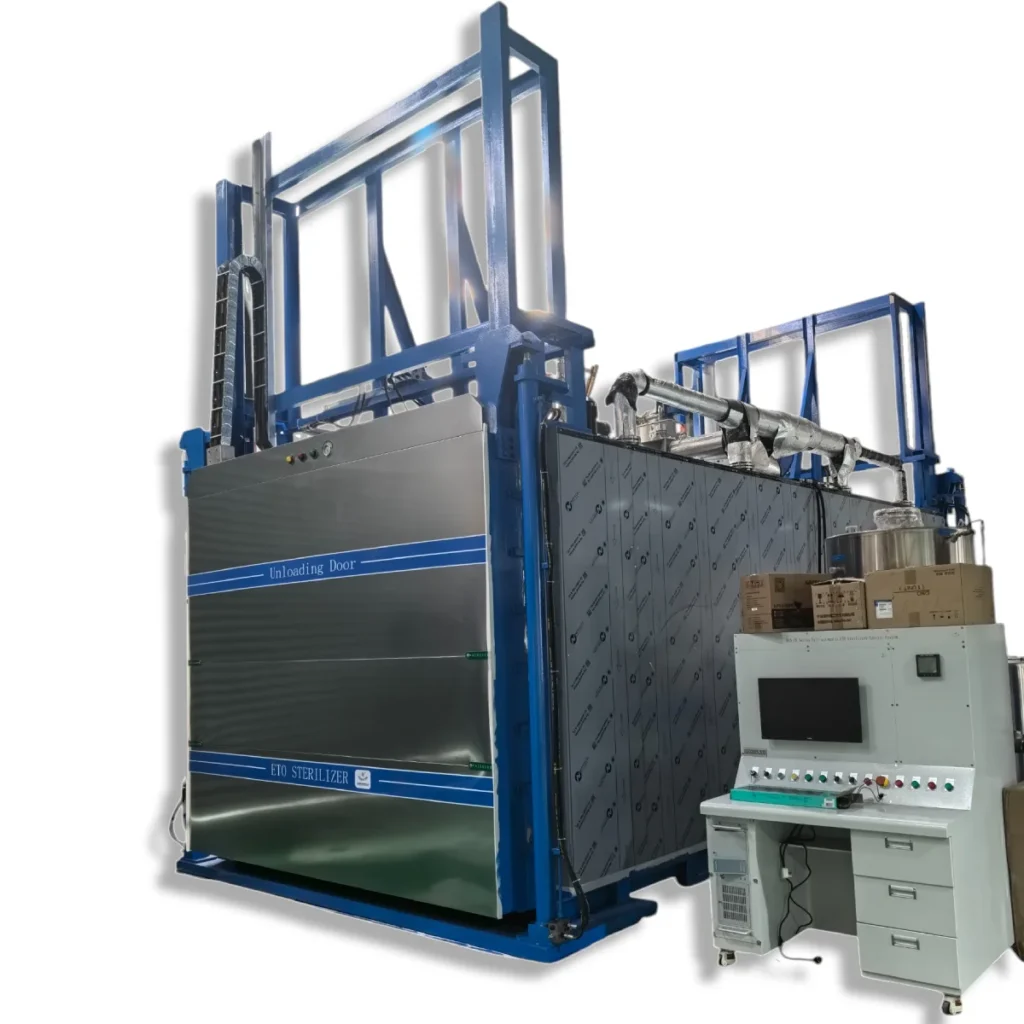
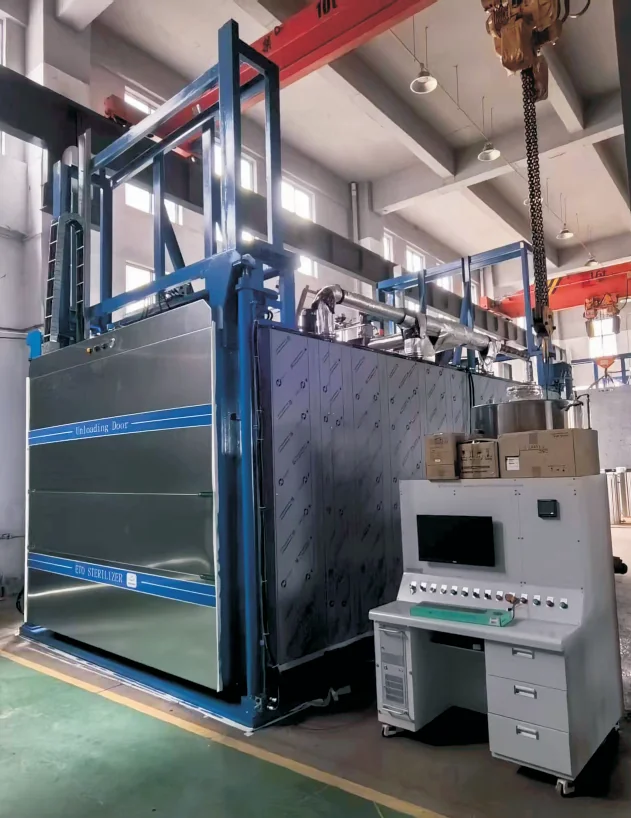
Start with the pressure boundary. An ETO sterilizer manufacturer should be able to name the plant that welds its chambers. Chamber bodies are welded stainless steel — typically 304 or 316L — with door frames, reinforcement rings, and jacket structures that must withstand repeated vacuum and pressure cycling. It should also be able to state which rolling equipment forms the shell, which welding processes are used, and what pressure-vessel qualification the workshop holds.
BOCON manufactures in Jiashan, Jiaxing, across two sites: Luoxing for control cabinets, R&D, and offices, and Huimin for chamber body production. Welding is TIG and MIG, and the group’s manufacturing partner Meikesi holds Grade D and ASME pressure-vessel capability with a 180-person workforce. That matters commercially as well as technically: the chamber is the long-lead item, and a supplier that schedules its own shell production controls the delivery date instead of forecasting it.
Controlar 2: Is There a Real Series Architecture?
A manufacturer that builds to order from a blank sheet cannot give you a comparable quotation, because every option is priced from scratch. A series architecture does the opposite: it fixes the control functions per tier, so the buyer can see what is standard, what is optional, and what is simply not available on the model being quoted.
BOCON’s range is organised into BE, LE, GE, and HE series, with a published control-function matrix covering 55 items — chamber temperature and pressure loops, humidity control, water-tank and vaporizer temperatures, EO concentration, magnetic-drive fan diagnostics, vacuum-pump water flow, leak-test routines, nitrogen blanketing, and remote service access. The matrix marks each function as standard, optional, or unavailable per series, which is exactly the document a technical buyer should demand before comparing prices.
Series logic also extends downward. The hospital and laboratory range uses the same control philosophy in a smaller envelope, so a company standardising on one supplier can deploy the same recipe structure and the same report format in a pilot lab and a production hall.
Controlar 3: Do the Recipes Go Beyond a “Standard Cycle”?
Anyone can program a vacuum, a gas charge, and a dwell. The engineering question is how the controller handles the two process families that dominate medical-device work: mixed-gas cycles with a nitrogen-free atmosphere, and full-nitrogen protection cycles for loads that must be kept below the flammable limit throughout.
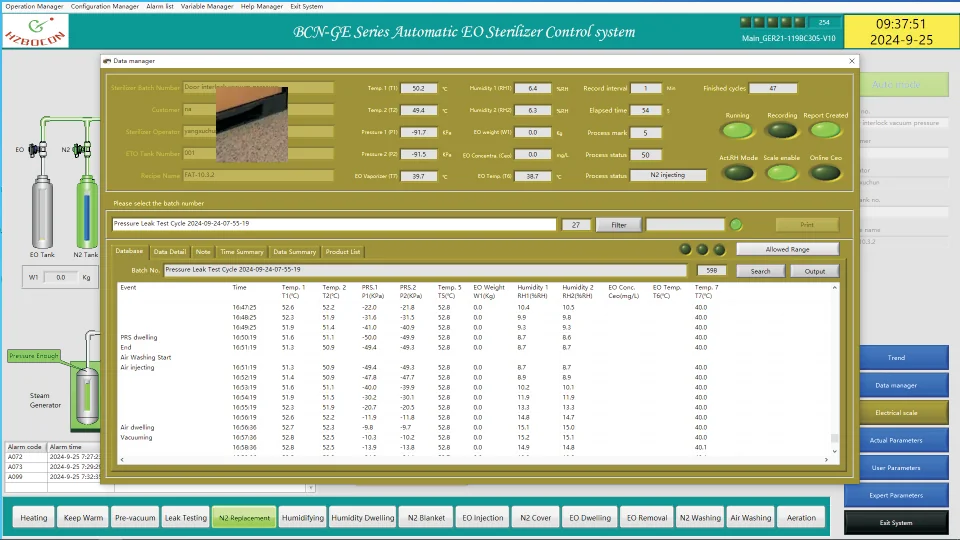
BOCON’s controller ships with both. The C10 mixed-gas sequence runs 13 steps from heating to aeration; the N20 full-nitrogen sequence runs 15, inserting air-to-nitrogen replacement, a nitrogen blanket before EO admission, an N2 cover during exposure, and an N2 wash before air washing. The two extra steps are the difference between a cycle that meets a flammable-limit specification and one that merely removes the gas afterwards.
| # | C10 mixed-gas sequence | N20 full-nitrogen sequence |
|---|---|---|
| 1 | Calefacción | Calefacción |
| 2 | mantener caliente | mantener caliente |
| 3 | Pre-vacío | Pre-vacío |
| 4 | Pruebas de fugas | Pruebas de fugas |
| 5 | Humidifying | Air to N₂ replacement |
| 6 | Vivienda de humedad | Humidificar la cámara |
| 7 | EO injection 1 | Vivienda de humedad |
| 8 | EO injection 2 | N₂ blanket to the chamber |
| 9 | EO injection 3 | Inyección de EO a la cámara. |
| 10 | EO dwelling | N₂ cover |
| 11 | eliminación de AE | EO dwelling |
| 12 | Lavado de aire | eliminación de AE |
| 13 | Aireación | N₂ washing |
| 14 | — | Lavado de aire |
| 15 | — | Aireación |
Controlar 4: Can the Control System Prove What Happened?
Under ISO 11135:2014, parametric release is a declaration that product is sterile based on records showing the process parameters were delivered within tolerance. The sterilizer therefore has to produce evidence, not just run a cycle: parameter traces at defined intervals, alarm history, operator actions, and a conclusion that can be signed.
BOCON’s software prints a defined report set — data summary, detailed data, trend chart, annotation table with the abbreviation key, and an EO sterilization process parameters conclusion with pass/fail per parameter. The controller can run as a separate cabinet or an integrated console, and the MES layer connects sterilizers to a SCADA/OPC server, workshop PCs, and label printers so that batch records are assembled without manual transcription.
Controlar 5: Does the FAT Match Your Validation Plan?
Factory acceptance testing is where an ETO sterilizer manufacturer’s confidence becomes visible. A thin FAT checks that the machine powers up; a useful one reproduces the tests that will later appear in the installation and operational qualification.
BOCON’s FAT protocol covers positive and negative leak tests, vacuum and vent speed, humidification and heating rate, internal circulation, temperature and humidity uniformity, and a complete cycle. After installation, the same data feeds IQ and OQ, and the software is validated alongside the equipment with operator training. The equipment is built to ISO 11135 y ES 1422, with quality management under ISO 13485 — the standards that a Notified Body or an internal auditor will ask about first.
Controlar 6: Is the Station Engineered Around the Chamber?
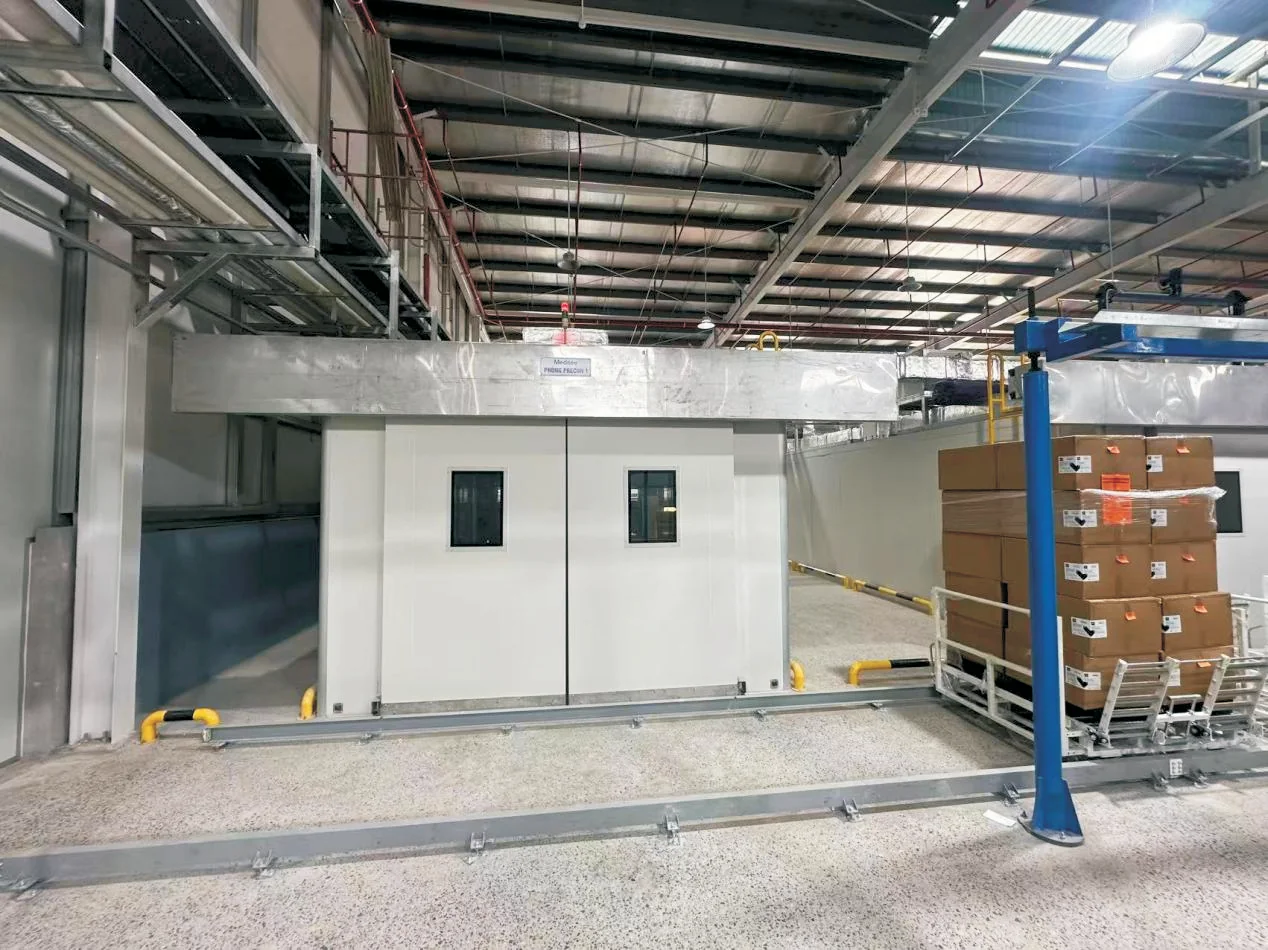
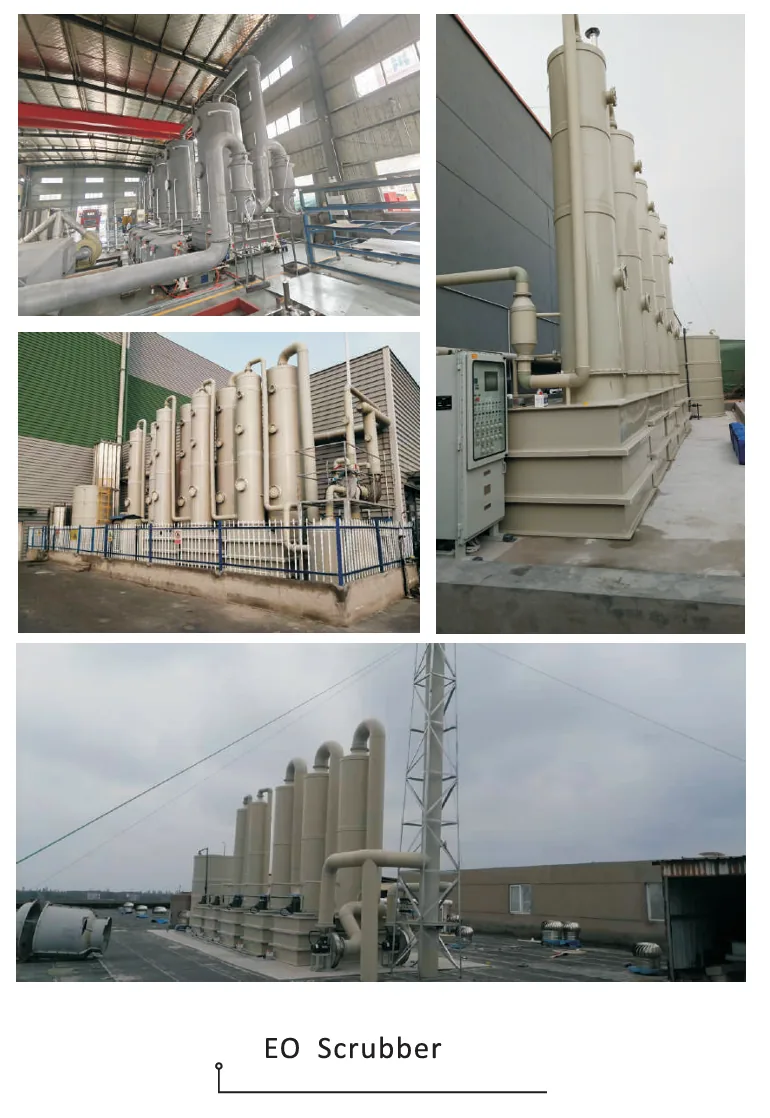
A sterilizer that arrives without its station is a bottleneck with a serial number. Preconditioning determines whether loads enter the chamber at the specified temperature and humidity; aeration determines when they can leave; the scrubber determines whether the site can operate at all under local emission rules.
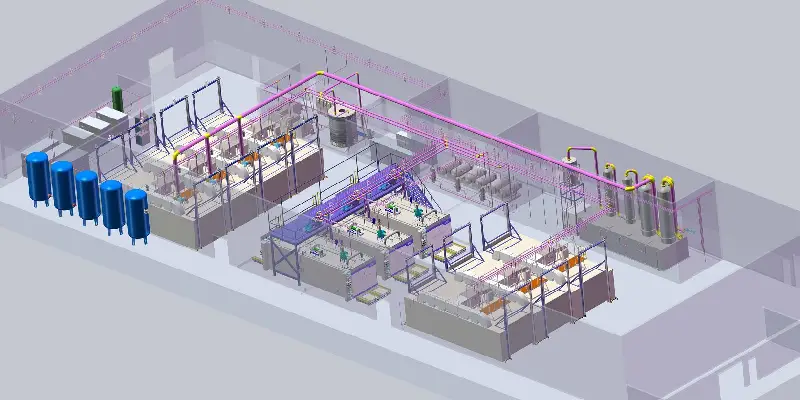
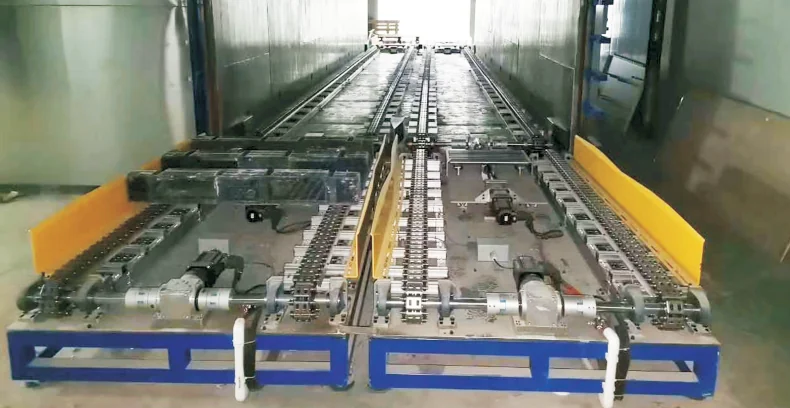
BOCON designs the station in 3D before the building drawing is fixed, and supplies the surrounding scope: preconditioning and aeration rooms, automatic conveyors and transfer cars, EO scrubbers, EO recovery, and EG burners for residual gas destruction. For a pharma or medical-device plant, that single-scope responsibility removes the interface risk that appears when the sterilizer vendor, the HVAC contractor, and the abatement supplier each assume someone else sized the aeration area.
Controlar 7: Will the Manufacturer Still Be There in Year Eight?
An ETO station is a twenty-year asset with a ten-year validation trail. The relevant question is not the warranty length but the support model: can the manufacturer access the controller remotely with the customer’s permission, are there engineers in the customer’s time zone, and does the software remain serviceable after the hardware generation changes?
BOCON supports installed systems through Zhejiang Bocon Intelligent Equipment, with remote diagnostics over secure connections, after-sales engineers distributed across time zones, and a documented remote-service period that extends beyond the standard warranty on the larger series. For a contract sterilizer running two shifts, that response path is worth more than a discount on the original order.
The Laboratory and Hospital Range
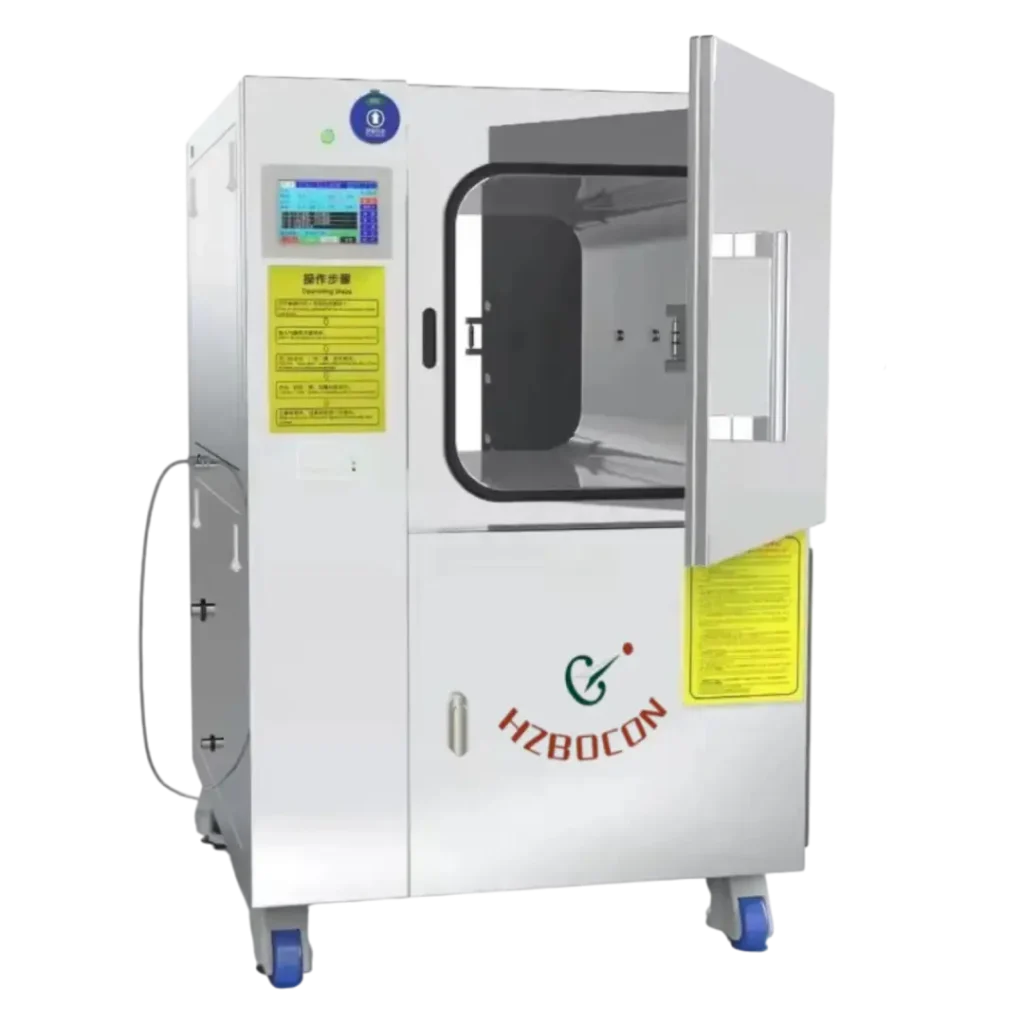
Not every validation starts at 10 metro³. Formulation labs, hospital central sterile services, and pilot plants need a chamber measured in litres, with the same record quality as the production unit. BOCON’s BCS range covers 78 L to 900 L with 304 stainless chambers, −80 kPa sterilization pressure, 40–80 % RH, and EO cartridge dosing instead of a bulk gas supply.
| Modelo | Chamber volume | Internal L × W × H (milímetros) | Fuerza | EO cartridge | Cycle at 55 °do |
|---|---|---|---|---|---|
| BCS-78 | 78 l | 610 × 420 × 300 | 1.4 kilovatios | 70 gramo | 8–10 h |
| BCS-138 | 138 l | 840 × 430 × 380 | 2.3 kilovatios | 100 gramo | 8–10 h |
| BCS-238 / 238D | 238 l | 950 × 500 × 500 | 3.4 kilovatios | 170 gramo | 8–12 h |
| BCS-600 | 600 l | 860 × 700 × 1000 | 7.5 kilovatios | 180 gramo × 2 | 10–15 h |
| BCS-900 | 900 l | 1290 × 700 × 1000 | 10 kilovatios | 180 gramo × 3 | 15–20 h |
Why BOCON Builds Rather Than Resells
As an ETO sterilizer manufacturer rather than a trading house, Hangzhou Bocon Mechanical and Electrical Equipment was established in 2006 and has sold sistemas industriales de esterilización ETO into 45 países, with chamber capacities from 1 m³ to 110 m³. The company designs and manufactures the chamber, the control cabinet, and the sterilization software in-house; the wider scope covers preconditioning and aeration rooms, transportadores, scrubbers, EO recovery, and nitrogen and steam support equipment. Zhejiang Bocon Intelligent Equipment was established in 2022 to consolidate manufacturing and after-sales under one organisation.
That structure is the answer to the seven checks above, and it is also the reason the checks are worth running: a buyer who can trace the chamber, the recipe editor, the FAT report, and the service engineer back to one manufacturer has removed most of the validation risk before the first pallet is loaded.
Preguntas frecuentes
How do I verify that a supplier is a genuine ETO sterilizer manufacturer?
Ask for the pressure-vessel qualification of the workshop, the name of the plant that welds the chamber, and a software version history for the controller. A manufacturer answers all three from its own records; a trader forwards the question.
What should a factory acceptance test include for an ETO sterilizer?
At minimum: positive and negative leak tests, vacuum and vent speed, heating and humidification rate, internal circulation, temperature and humidity uniformity, and a complete cycle with a report. These should map directly onto the IQ/OQ tests performed on site.
Is full-nitrogen protection necessary for every load?
No. Mixed-gas C10 cycles suit many medical-device loads. Full-nitrogen N20 sequences are specified when the process must stay below the flammable limit throughout, which adds nitrogen replacement, blanketing, cover, and washing steps.
Can the sterilizer connect to an existing MES or SCADA system?
Sí, where the controller exposes the required interfaces. BOCON systems support SCADA/OPC connectivity, workshop PC monitoring, label printing, and server-based archiving so batch records can be assembled without manual transcription.
What capacity range can a single manufacturer cover?
BOCON builds from 78 L laboratory units to 110 m³ two-row industrial chambers, including the 1–20 metro³ single-row sizes used by contract sterilizers and device plants. Sizes between the standard steps are engineered to order.
Qualifying ETO Sterilizer Manufacturers This Quarter?
Send your load profile, cycle specification, and site constraints. We return a chamber recommendation, a control-function comparison for the relevant series, and a FAT outline you can put in the tender pack.
Chatea con un ingeniero en WhatsApp Solicitar una propuesta técnicaReferencia: ISO 11135:2014, 3.25 (parametric release) · EN 1422 · ISO 13485 · ISO 10993-7:2008 (residual limits). Figures reflect the current BOCON catalogue and are confirmed on the approved drawing for each order.