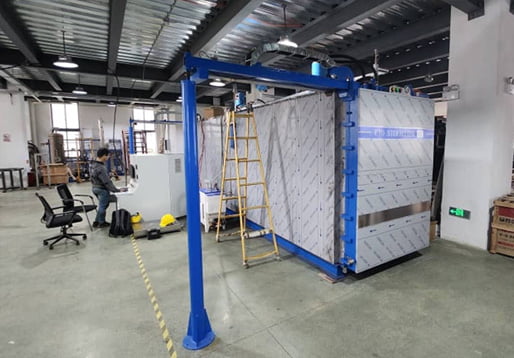
Chamber Leak Tightness Test for Ethylene Oxide Sterilizers
A properly sealed sterilization chamber is fundamental to maintaining the required ethylene oxide concentration and pressure conditions throughout the cycle. The following leak tightness tests are performed on an empty chamber to detect any unacceptable leakage that could compromise sterility assurance or operator safety. These procedures align with the performance validation protocols for industrial ETO sterilizers.
Key Principle: Leak testing verifies the integrity of the sterilization chamber under both negative and positive pressure conditions, ensuring that no external contaminants enter or sterilant gas escapes during operation.
General Test Requirements
All leak tests must be conducted with an empty sterilization chamber. After an automatic test cycle completes, filtered air is introduced until the chamber pressure returns to within ±5 kPa of ambient atmospheric pressure. For non-automatic test methods, equivalent provisions must be made to achieve the same pressure equalization before proceeding with measurements.
If required, a stabilization period of 300s ±10s may be set before pressure monitoring begins. During this time, all valves connected to the chamber are closed and the vacuum pump (if used) is stopped. The subsequent observation period is 12 hours, long enough for a genuine leak to separate from thermal drift.
Negative Pressure Leak Test
The negative pressure leak test evaluates the chamber’s ability to hold vacuum, which is critical for the evacuation phases of a sterilization cycle. The test pressure is -90 kPa: deep enough to exceed any production cycle. This ensures the chamber is tested under the most demanding vacuum conditions it may experience in service.
Procedure: Evacuate the empty chamber to the specified negative test pressure. Close all valves connected to the chamber and stop the vacuum pump completely. After the 15-minute balance, monitor and record the pressure continuously for 12 hours. The average vacuum leakage rate must not exceed 0.3 kPa/h once the temperature effect of about 0.34 kPa per °C is deducted. Any increase beyond the limit indicates a potential breach in chamber integrity that must be investigated and corrected before the sterilizer is placed into service.
Positive Pressure Leak Test
The positive test is specified separately from the vacuum test: the chamber is empty and sealed, brought to a steady 30-50 °C (above ambient), pressurised to +80 kPa, balanced for 15 minutes and then held for 12 hours. The average leakage rate must not exceed 0.3 kPa/h after deducting the temperature effect of roughly 0.34 kPa per °C.
The positive pressure leak test verifies the chamber’s ability to contain elevated pressures without leakage. The test pressure must be no lower than the highest set pressure of any sterilization cycle, ensuring the chamber is evaluated under worst-case positive pressure conditions.
Special considerations for heated chambers: If the test is performed in a heated chamber, temperature variations can influence pressure readings and affect the calculated leak rate. Therefore, after reaching the test pressure, a stabilization period must be observed until the temperature stabilizes, plus an additional 120 seconds, before the monitoring phase begins. This compensates for any pressure changes caused by thermal effects.
With all valves closed and the pressure source isolated, record the pressure for 12 hours. The average leakage rate over that period must not exceed 0.3 kPa/h once the temperature effect is deducted. Consistent monitoring ensures that even minor leaks are detected and addressed promptly.
Ensure your ETO sterilizer meets the highest integrity standards
Contact HZBOCON for expert support with chamber leak testing, factory acceptance protocols, and comprehensive validation services.
Chat with us on WhatsAppKey figures
| Parameter | Requirement | Note |
|---|---|---|
| Stabilisation period | 15 minutes | Chamber held at a steady 30-50 °C, above ambient |
| Observation window | 12 hours | Pressure recorded continuously, then averaged over the hold |
| Negative test pressure | -90 kPa | Temperature-corrected (about 0.34 kPa per °C) |
| Pressure restoration | Filtered air until within ±5 kPa of ambient | Before the chamber is opened |
| Positive pressure test | When working pressure exceeds 5 kPa: +80 kPa, 15 min balance, 12 h hold, average rate ≤0.3 kPa/h | Temperature-corrected (about 0.34 kPa per °C); confirms the chamber contains pressure without leaking outward |
| Acceptance | Average vacuum leakage rate ≤0.3 kPa/h | Measured after deducting the temperature effect |
Frequently asked questions
What vacuum level is used for the negative pressure leak test?
The chamber is evacuated to -90 kPa, balanced for 15 minutes and held for 12 hours. That is deeper than any production cycle, so the test proves the chamber at its real working limit rather than at an arbitrary figure, and the 0.3 kPa/h limit is applied after the temperature correction.
How long must the pressure be monitored?
12 hours of continuous recording, after a 15-minute balance at a steady 30-50 °C. Shorter windows cannot separate a genuine leak from normal pressure drift on a large chamber.
When is a positive pressure test required?
When the sterilizer operating pressure is greater than 5 kPa. The positive test complements the vacuum test: one proves the chamber holds vacuum, the other proves it holds pressure without leaking sterilant.
What counts as a pass?
The average leakage rate over the 12-hour hold must stay at or below 0.3 kPa/h, measured after the temperature effect of about 0.34 kPa per °C is deducted from the observed pressure change.
How is the chamber prepared before the test?
The chamber is empty and dry. After the test cycle, filtered air is introduced until pressure returns to within ±5 kPa of ambient atmospheric pressure, so the chamber is never opened under vacuum or with residual EO.