4.4 Determination of Ethylene Oxide (EO) and ECH Residuals
Expert summary and technical interpretation of the 2026 updated protocols for sterilization residual analysis.
4.4.1 General Procedure
The procedure to determine conformity with Allowable Limits (AL) consists of four critical pillars:
- Extraction: Removing residuals from representative samples.
- Determination: Quantifying the amount of residual (EO/ECH).
- Surface Analysis: Determining the contact surface area of the device.
- Data Interpretation: Analyzing results against Annex A, B, C, and J of ISO 10993-7:2026.
4.4.2 Test Method Validation
A valid method for extraction and measurement is mandatory to ensure patient safety. Gas Chromatography (GC) remains the gold standard for EO and ECH analysis (see Annex H and I).
| Requirement Category | Minimum Validation Parameters |
|---|---|
| System Suitability | Demonstration of accuracy, precision (repeatability & reproducibility), and specificity (sensitivity & selectivity). |
| Analytical Range | Verification of detection limits (LOD), quantification limits (LOQ), linearity, and range. |
| Guideline Alignment | Validation must align with ICH Harmonized Tripartite Guidelines to meet minimum international requirements. |
4.4.3 Product Sampling & Worst-Case Conditions
Samples must be representative of the finished product. ISO 10993-7:2026 emphasizes the Worst-Case Scenario, which includes:
- Allowed double or triple sterilization cycles.
- Minimum specified aeration times.
- Retrieval and handling factors described in Annex A and B.
4.4.5 Product Extraction Strategy
The aim is to determine the worst-case amount delivered to the patient during actual use. The choice of method depends on exposure duration:
Simulated-Use Extraction
Evaluates the cumulative dose based on how the device is used in clinical practice. Recommended if exhaustive extraction exceeds AL.
Exhaustive Extraction
Total removal of residuals. If exhaustive results are within AL limits, further simulated-use testing is not required.
4.4.6 Multi-Device Systems & Kits
Multi-device systems: Must be assessed to determine if components should be tested individually or as an assembled unit (Clause A.8).
Convenience kits: For products used independently, limits may be applied using the appropriate CEF or calculated for the entire kit. If the device count differs from the default (5 devices), the CEF must be adjusted accordingly.
Achieve Compliance with ISO 10993-7:2026
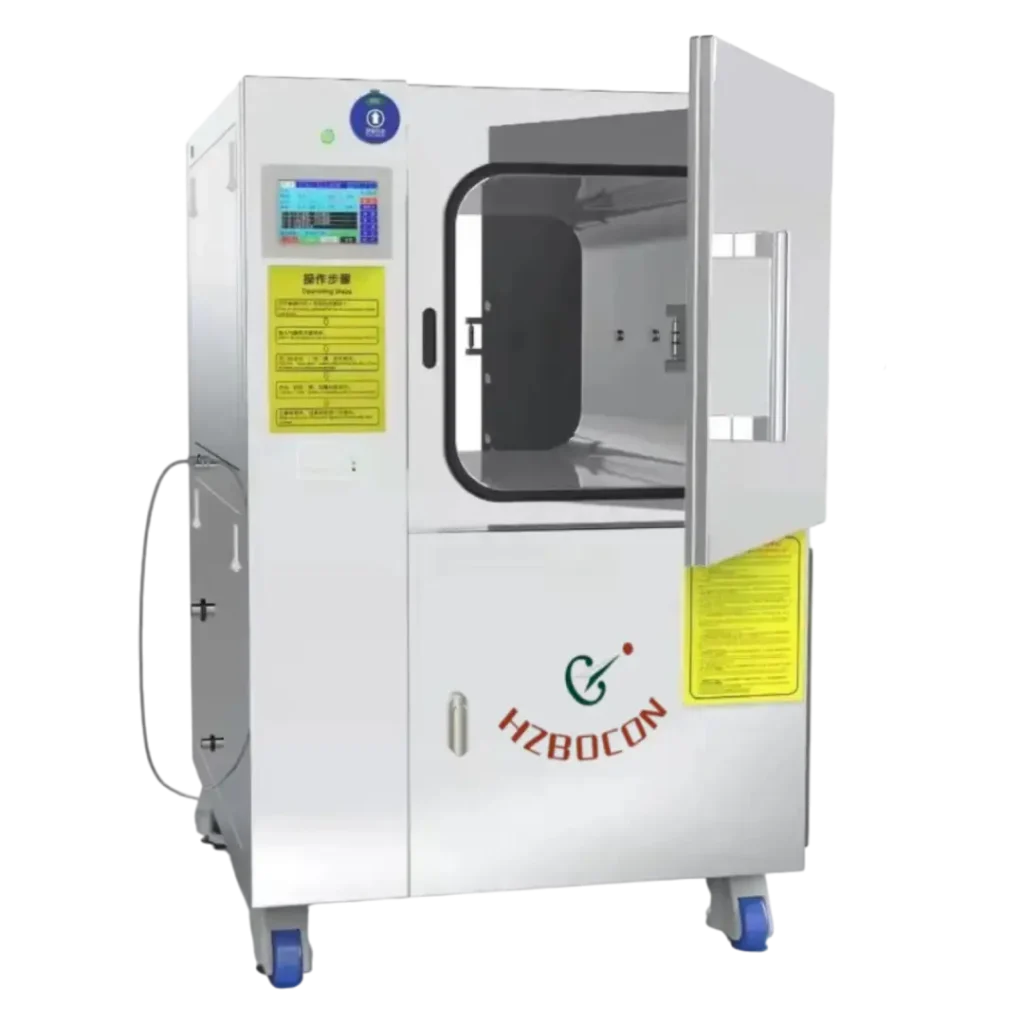
BOCON’s advanced aeration and sterilization systems are designed to help you meet the most stringent EO residual limits efficiently.
Frequently asked questions
Which analytes does ISO 10993-7:2026 cover?
Ethylene oxide (EO) and ethylene chlorohydrin (ECH). Results are interpreted against Annex A, B, C and J of the standard, with J covering multi-device systems and kits.
What must be validated before routine residue testing?
The test method itself, per section 4.4.2: accuracy, precision (repeatability and reproducibility) and specificity. A method that has not been validated cannot support a release decision, however good the numbers look.
How is the worst-case device selected?
Section 4.4.3 sets the sampling and worst-case rules. The device tested must represent the family, so the result can be extended to the rest of the load without testing every variant.
How is the sample extracted?
Section 4.4.5 defines the extraction strategy: the device is exposed to a defined volume of extracting medium for a defined time, and the resulting solution is analysed by gas chromatography.
How are kits and multi-device systems handled?
Section 4.4.6 covers them. Each device in a kit carries its own residue contribution, so the limits apply per device even when the products are packed and sterilized together.