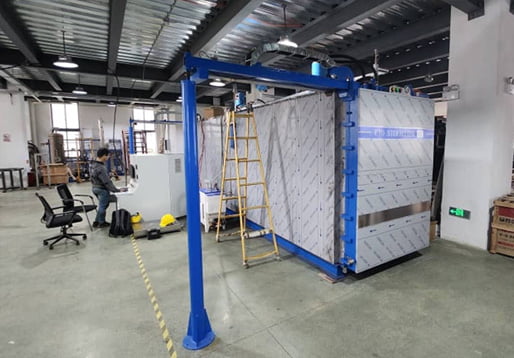
Test di tenuta della camera per sterilizzatori a ossido di etilene
Una camera di sterilizzazione adeguatamente sigillata è fondamentale per mantenere la concentrazione di ossido di etilene e le condizioni di pressione richieste durante tutto il ciclo. I seguenti test di tenuta vengono eseguiti su una camera vuota per rilevare eventuali perdite inaccettabili che potrebbero compromettere la garanzia di sterilità o la sicurezza dell'operatore. Queste procedure sono in linea con i protocolli di convalida delle prestazioni per sterilizzatori industriali ETO.
Principio chiave: Il test delle perdite verifica l'integrità della camera di sterilizzazione in condizioni di pressione sia negativa che positiva, garantire che durante il funzionamento non entrino contaminanti esterni o fuoriesca gas sterilizzante.
Requisiti generali del test
All leak tests must be conducted with an empty sterilization chamber. After an automatic test cycle completes, filtered air is introduced until the chamber pressure returns to within ±5 kPa of ambient atmospheric pressure. For non-automatic test methods, equivalent provisions must be made to achieve the same pressure equalization before proceeding with measurements.
If required, a stabilization period of 300s ±10s may be set before pressure monitoring begins. During this time, all valves connected to the chamber are closed and the vacuum pump (if used) is stopped. The subsequent observation period is 12 ore, long enough for a genuine leak to separate from thermal drift.
Negative Pressure Leak Test
The negative pressure leak test evaluates the chamber’s ability to hold vacuum, che è fondamentale per le fasi di evacuazione di un ciclo di sterilizzazione. The test pressure is -90 kPa: deep enough to exceed any production cycle. Ciò garantisce che la camera venga testata nelle condizioni di vuoto più impegnative che potrebbe incontrare durante il servizio.
Procedura: Evacuare la camera vuota alla pressione di prova negativa specificata. Chiudere tutte le valvole collegate alla camera e arrestare completamente la pompa del vuoto. After the 15-minute balance, monitor and record the pressure continuously for 12 ore. The average vacuum leakage rate must not exceed 0.3 kPa/h once the temperature effect of about 0.34 kPa per °C is deducted. Qualsiasi aumento oltre il limite indica una potenziale violazione dell'integrità della camera che deve essere indagata e corretta prima che lo sterilizzatore venga messo in servizio.
Prova di tenuta a pressione positiva
The positive test is specified separately from the vacuum test: the chamber is empty and sealed, brought to a steady 30-50 °C (above ambient), pressurised to +80 kPa, balanced for 15 minutes and then held for 12 ore. The average leakage rate must not exceed 0.3 kPa/h after deducting the temperature effect of roughly 0.34 kPa per °C.
Il test di tenuta a pressione positiva verifica la capacità della camera di contenere pressioni elevate senza perdite. La pressione di prova non deve essere inferiore alla pressione massima impostata per qualsiasi ciclo di sterilizzazione, garantendo che la camera venga valutata nelle peggiori condizioni di pressione positiva.
Considerazioni speciali per le camere riscaldate: Se il test viene eseguito in una camera riscaldata, le variazioni di temperatura possono influenzare le letture della pressione e influenzare il tasso di perdita calcolato. Perciò, dopo aver raggiunto la pressione di prova, è necessario osservare un periodo di stabilizzazione finché la temperatura non si stabilizza, più un ulteriore 120 secondi, prima che inizi la fase di monitoraggio. Ciò compensa eventuali variazioni di pressione causate da effetti termici.
Con tutte le valvole chiuse e la fonte di pressione isolata, record the pressure for 12 ore. The average leakage rate over that period must not exceed 0.3 kPa/h once the temperature effect is deducted. Un monitoraggio costante garantisce che anche le perdite più piccole vengano rilevate e risolte tempestivamente.
Assicurati che il tuo sterilizzatore ETO soddisfi i più elevati standard di integrità
Contattare HZBOCON per il supporto di esperti con il test di tenuta della camera, protocolli di accettazione in fabbrica, e servizi di convalida completi.
Chatta con noi su WhatsAppKey figures
| Parameter | Requirement | Nota |
|---|---|---|
| Stabilisation period | 15 minuti | Chamber held at a steady 30-50 °C, above ambient |
| Observation window | 12 ore | Pressure recorded continuously, then averaged over the hold |
| Negative test pressure | -90 kPa | Temperature-corrected (about 0.34 kPa per °C) |
| Pressure restoration | Filtered air until within ±5 kPa of ambient | Before the chamber is opened |
| Positive pressure test | When working pressure exceeds 5 kPa: +80 kPa, 15 min balance, 12 h hold, average rate ≤0.3 kPa/h | Temperature-corrected (about 0.34 kPa per °C); confirms the chamber contains pressure without leaking outward |
| Acceptance | Average vacuum leakage rate ≤0.3 kPa/h | Measured after deducting the temperature effect |
Frequently asked questions
What vacuum level is used for the negative pressure leak test?
The chamber is evacuated to -90 kPa, balanced for 15 minutes and held for 12 ore. That is deeper than any production cycle, so the test proves the chamber at its real working limit rather than at an arbitrary figure, e il 0.3 kPa/h limit is applied after the temperature correction.
How long must the pressure be monitored?
12 hours of continuous recording, after a 15-minute balance at a steady 30-50 °C. Shorter windows cannot separate a genuine leak from normal pressure drift on a large chamber.
When is a positive pressure test required?
When the sterilizer operating pressure is greater than 5 kPa. The positive test complements the vacuum test: one proves the chamber holds vacuum, the other proves it holds pressure without leaking sterilant.
What counts as a pass?
The average leakage rate over the 12-hour hold must stay at or below 0.3 kPa/h, measured after the temperature effect of about 0.34 kPa per °C is deducted from the observed pressure change.
How is the chamber prepared before the test?
The chamber is empty and dry. After the test cycle, filtered air is introduced until pressure returns to within ±5 kPa of ambient atmospheric pressure, so the chamber is never opened under vacuum or with residual EO.