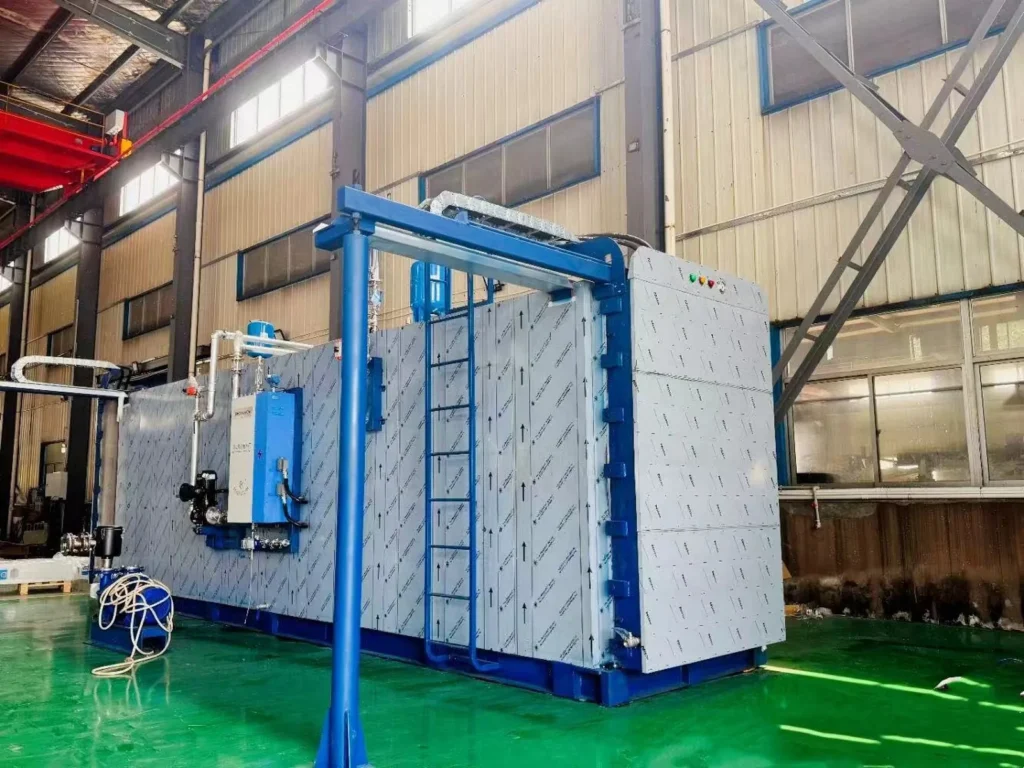
Sizing Guide · ISO 11135
Chamber volume is the first number every project team quotes and the last one that should be selected. For industrial ethylene oxide sterilizers, the practical decision starts with pallet count, door type, and the rooms on either side of the chamber — the cubic metre figure is simply the result.
Key principle: size the chamber from the pallet, not from the cubic metre. A 30 m³ vessel holds ten 1200 × 1000 mm pallets, and every downstream dimension — door clearance, ceiling height, aeration volume, scrubber capacity — follows from that count.
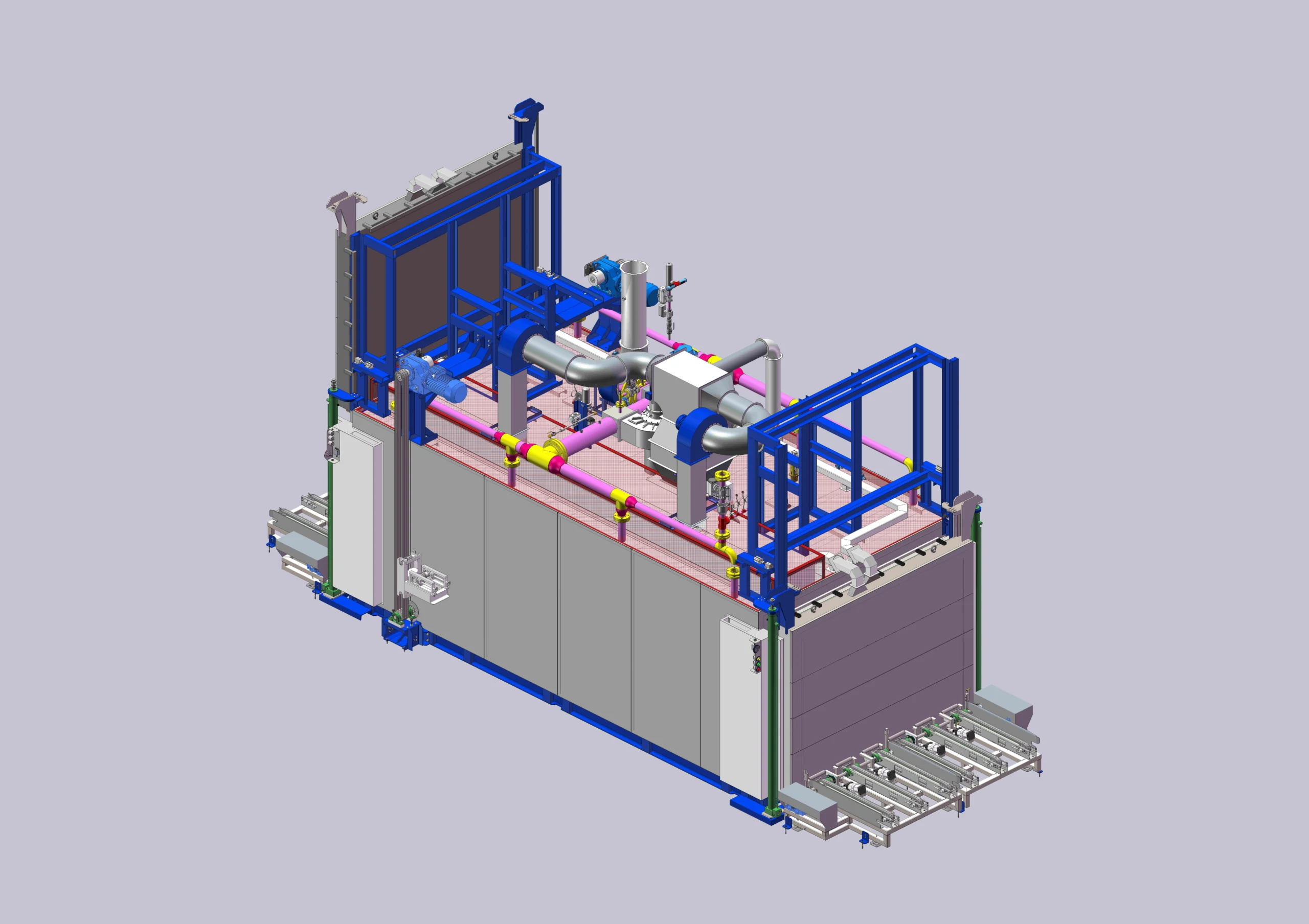
Why Chamber Volume Is a Poor Starting Point
A sterilizer rated at 30 m³ has an internal volume of 30 m³. It does not have 30 m³ of usable load space. Pallets do not tessellate against insulation, door frames, and air-distribution gaps, and the volumetric loading factor for a typical medical-device load sits near 70 %. A 10 m³ chamber therefore processes roughly 7 m³ of packaged product per batch — a figure that matters far more in production planning than the nameplate number.
The second reason is geometric. Comparing ETO sterilizer sizes on litres alone hides the difference: two chambers can share the same volume and behave very differently: a 11100 × 1350 × 2000 mm vessel is a single-file tunnel that accepts one pallet width, while a 7600 × 2700 × 2200 mm vessel of similar volume accepts two pallets side by side. The first suits a long, narrow conveyor line; the second suits a compact batch room. Neither is larger in litres. They are different buildings.
Standard ETO Sterilizer Sizes: 1 to 110 m³
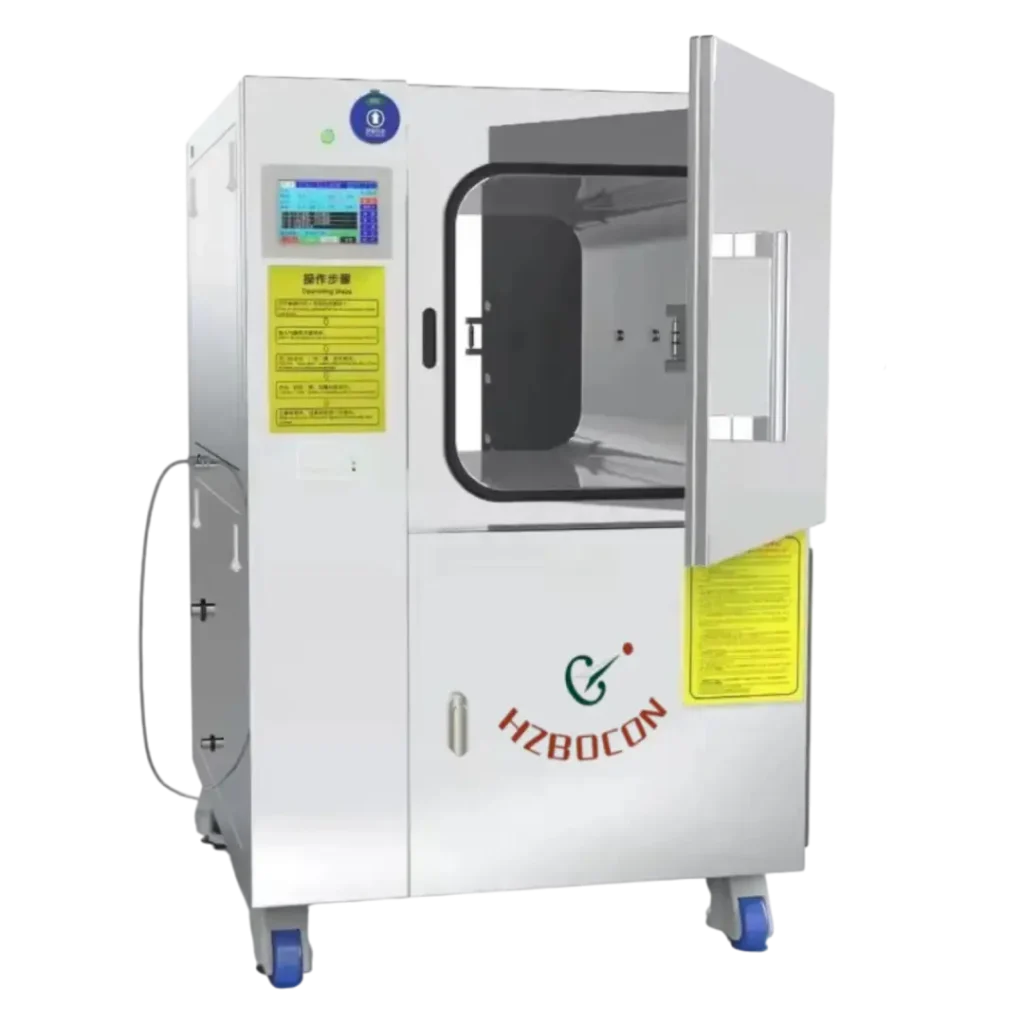
BOCON builds chambers from 1 m³ laboratory units to 110 m³ two-row industrial vessels. The table below lists representative ETO sterilizer sizes with internal dimensions, pallet capacity for a standard 1200 × 1000 mm pallet, and the external envelope with a sliding door. Every size in between is available, and non-standard envelopes are engineered to order.
| Volume | Pallets | Internal L × W × H (مم) | External, sliding door (مم) |
|---|---|---|---|
| 1 م³ | — | 1400 × 700 × 1000 | — |
| 3 م³ | 1 | 1400 × 1350 × 1700 | 1820 × 3220 × 2220 |
| 5 م³ | 2 | 2250 × 1350 × 1700 | 2670 × 3220 × 2220 |
| 10 م³ | 4 | 4500 × 1350 × 1700 | 4920 × 3220 × 2220 |
| 15 م³ | 5 | 5500 × 1350 × 2000 | 5920 × 3220 × 2520 |
| 20 م³ | 7 | 7500 × 1350 × 2000 | 7920 × 3220 × 2520 |
| 30 م³ | 10 | 11100 × 1350 × 2000 | 11520 × 3220 × 2520 |
| 45 م³ | 14 (2 × 7) | 7600 × 2700 × 2200 | 8050 × 6180 × 2720 |
| 63 م³ | 20 (2 × 10) | 10700 × 2700 × 2200 | 11150 × 6180 × 2720 |
| 76 م³ | 24 (2 × 12) | 12850 × 2700 × 2200 | 13300 × 6180 × 2720 |
| 90 م³ | 26 (2 × 13) | 13900 × 2700 × 2400 | 14350 × 6180 × 2920 |
| 110 م³ | 32 (2 × 16) | 17050 × 2700 × 2400 | 17500 × 6180 × 2920 |
Three patterns are worth noting. Chambers up to about 40 m³ keep a 1350 mm internal width — one pallet, loaded end to end. From 45 m³ the width doubles to 2700 mm and pallets are arranged two abreast, which shortens the vessel and the building. At the top of the range a 110 m³ chamber reaches 17 m in length, and the loading conveyor becomes a structural part of the project rather than an accessory.
Internal Dimensions vs External Footprint
The external envelope is what the civil works must accommodate, and it is not a small increment over the internal size. Insulation, the door mechanism, the frame, and the service gap add 0.8–1.0 m to length and roughly 1.85 m to width on a single-row sliding-door unit. For a 30 m³ chamber the footprint is 11.52 × 3.22 m, or about 37 m² before any maintenance clearance.
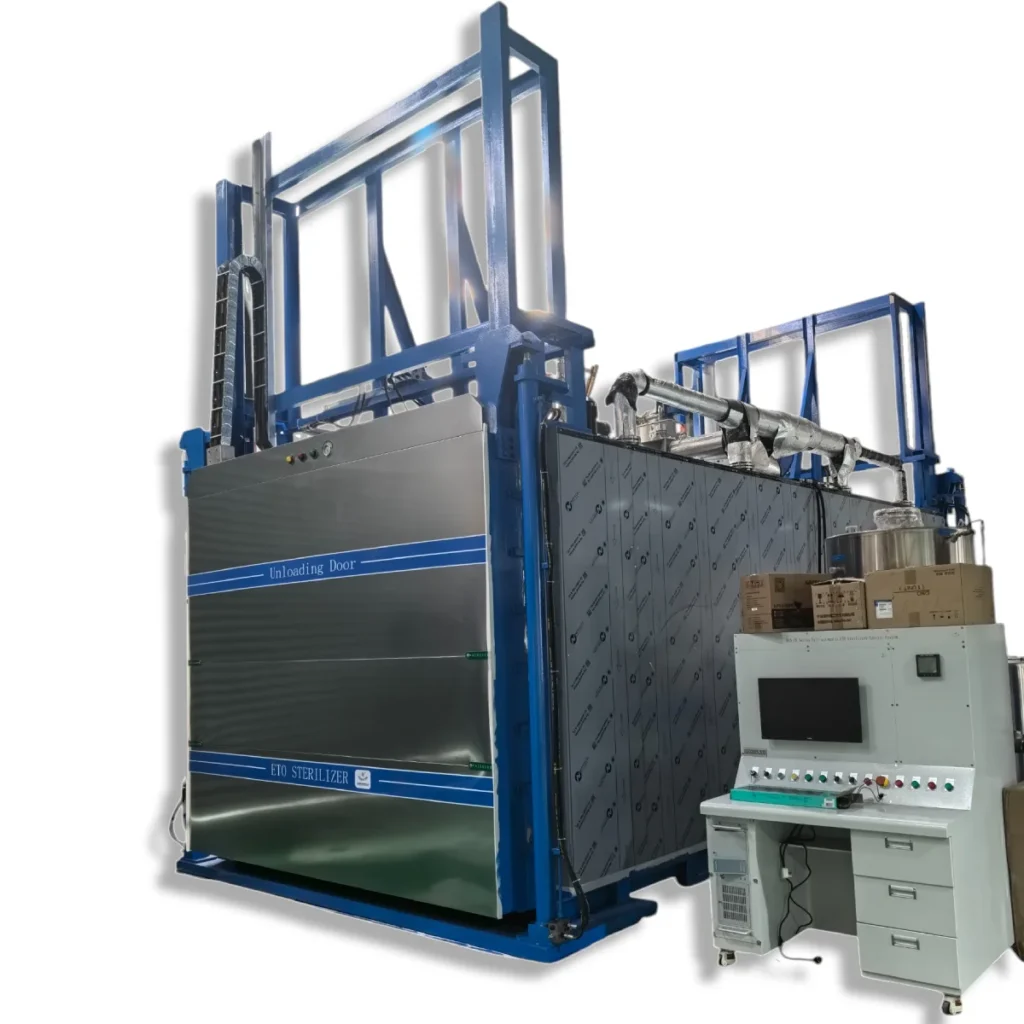
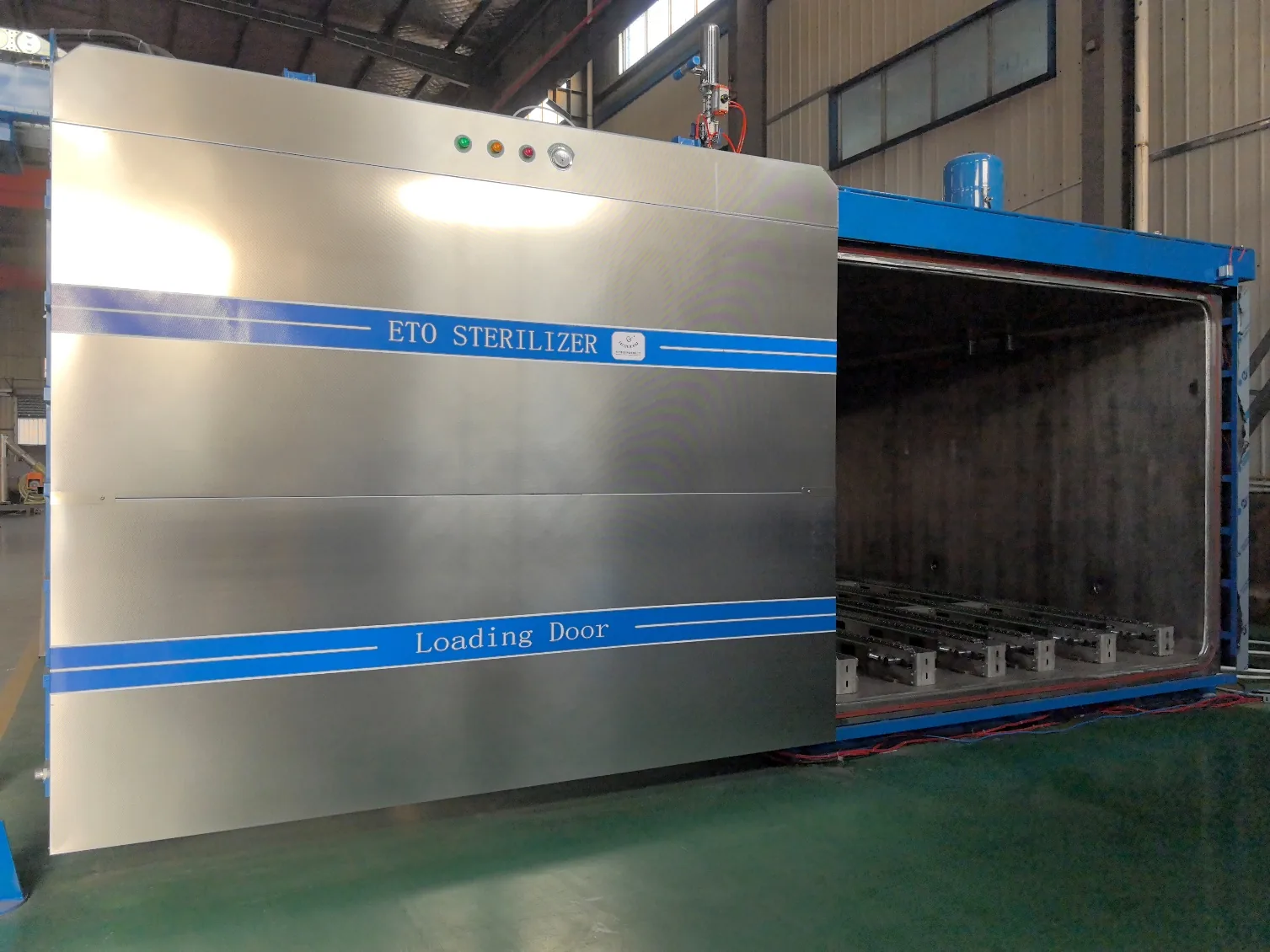
Door type changes the external dimensions more than any other single decision. The same 30 m³ vessel measures 11520 × 3220 × 2520 mm with a sliding door, 11450 × 1920 × 2520 mm with a revolving door, and 11520 × 1910 × 4550 mm with a lifting door. The sliding door buys a flat, conveyor-friendly interface at the cost of lateral space; the revolving door is the most compact; the lifting door trades floor area for headroom.
| Volume | Sliding door | Revolving door | Lifting door |
|---|---|---|---|
| 10 م³ | 4920 × 3220 × 2220 | 4850 × 1920 × 2220 | 4920 × 1910 × 3950 |
| 30 م³ | 11520 × 3220 × 2520 | 11450 × 1920 × 2520 | 11520 × 1910 × 4550 |
| 70 م³ | 12250 × 6180 × 2720 | 12150 × 3450 × 2780 | 12220 × 3380 × 5070 |
Matching the Chamber to Throughput
A complete EO cycle — preconditioning transfer, فارغ, الترطيب, التعرض للغاز, flushing, and aeration transfer — typically runs 8–10 hours, which yields two cycles per operating day in a well-managed facility. The actual duration is fixed by the performance qualification, not by the sales sheet, so treat these figures as planning values.
The calculation is then straightforward. Required pallets per day, divided by two cycles, gives the pallet capacity per cycle, which maps directly onto the table above. A facility that needs 20 pallets per day needs 10 pallets per cycle — a 30 m³ chamber. The same demand handled by a 10 m³ unit requires 2.5 cycles per day and leaves no margin for a failed run, a maintenance window, or a validation hold. That margin, not the pallet arithmetic, is usually what justifies the next size up.
Engineering note: a chamber can always be under-loaded; it can never be legitimately over-loaded. Routine loads must stay within the maximum load configuration established during PQ, so specify for the peak week rather than the average month.
Choosing the Door Type
- Sliding door: the default for automated lines. It presents a flat face to the conveyor, needs 3.2 m of lateral travel space on single-row units, and pairs naturally with a transfer car between preconditioning, تعقيم, والتهوية.
- Revolving door: the smallest external width — 1.92 m at 30 m³ — and the usual choice for laboratory and pilot chambers, cleanroom pass-through walls, and buildings where floor area is the binding constraint.
- Lifting door: opens vertically, so the floor in front of the chamber stays clear for pallet trucks and forklifts. It requires 3.95–5.07 m of ceiling height depending on capacity, which frequently drives the building height.
All three are available with explosion-proof interlocks, door-seal monitoring, and position feedback wired into the sterilization controller, because the door is both a pressure boundary and a personnel safety boundary.
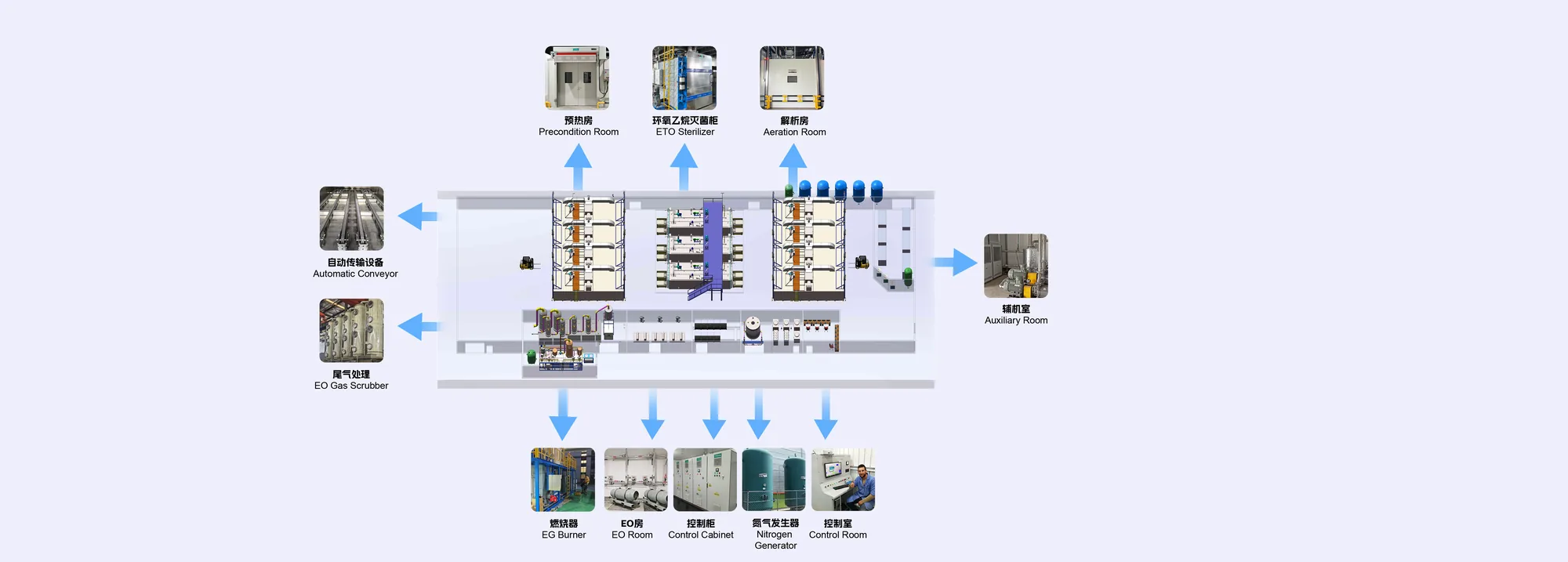
The Station Around the Chamber
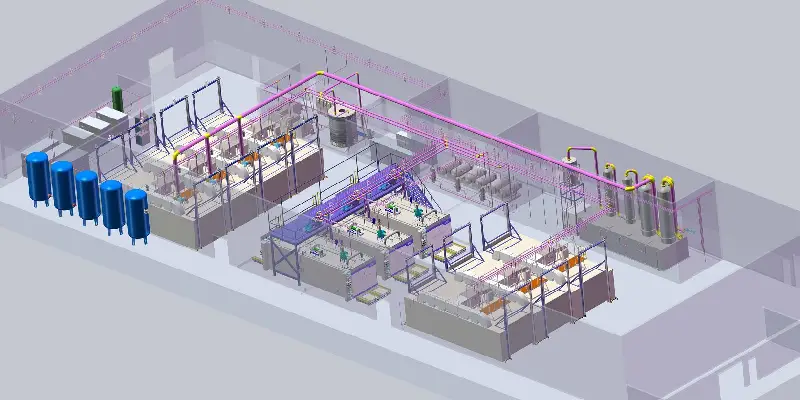
An ETO sterilizer is rarely a standalone machine. The chamber sits at the centre of a station that includes a preconditioning room, the sterilizer itself, an aeration room, EO waste-gas treatment, nitrogen generation, steam supply, and a control room. Sizing the chamber without sizing these neighbours produces a plant that cannot run at nameplate throughput.
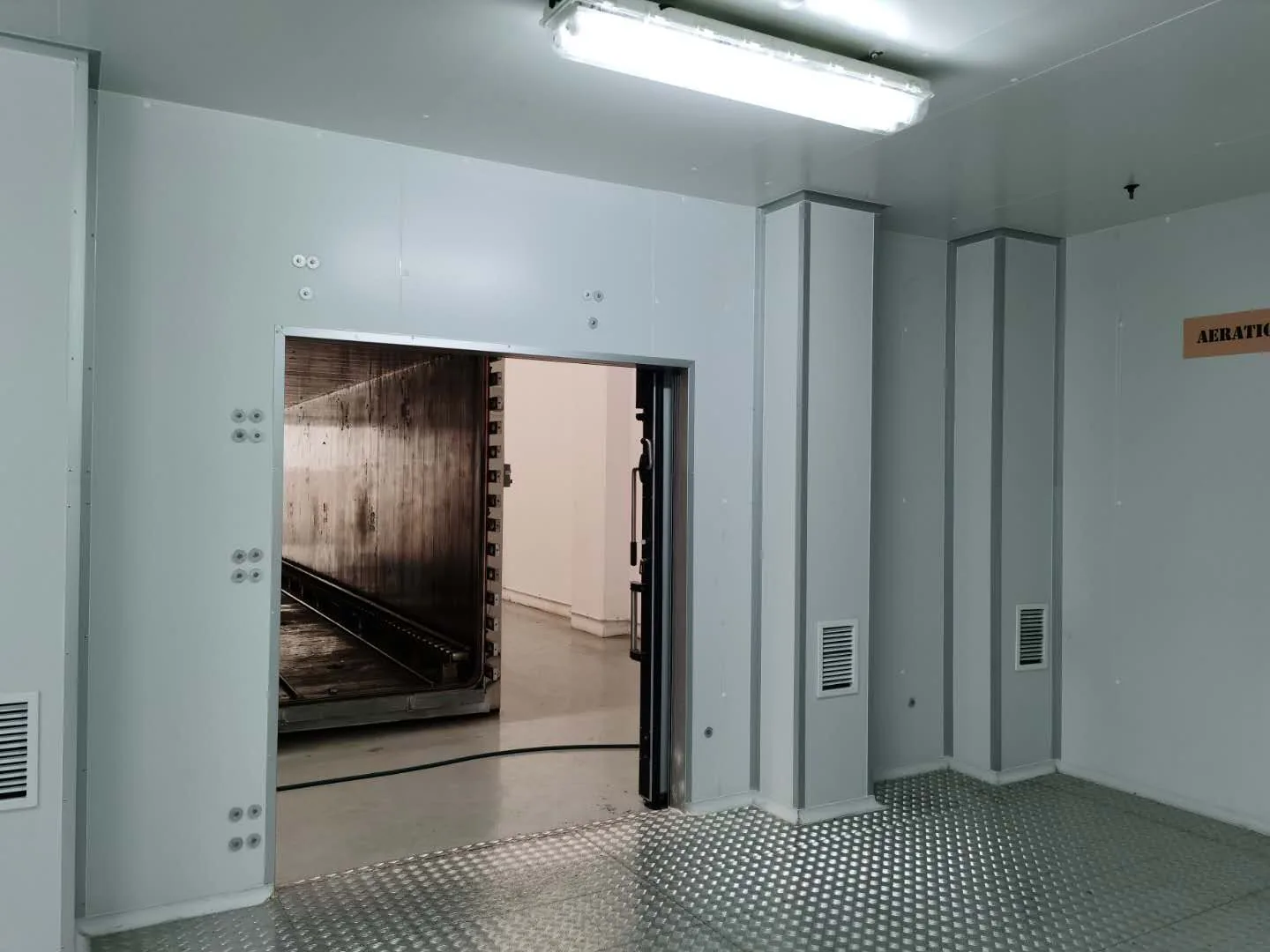
Aeration is the most common bottleneck. Residual EO desorbs from polymers over hours to days depending on material, load density, ودرجة الحرارة; large stations therefore use dedicated aeration rooms in the 650 m³ class with heated, forced ventilation. Preconditioning rooms are sized to the same batch rhythm so that loads arrive at the chamber at 40–50 % RH and 40–50 °C rather than at ambient.
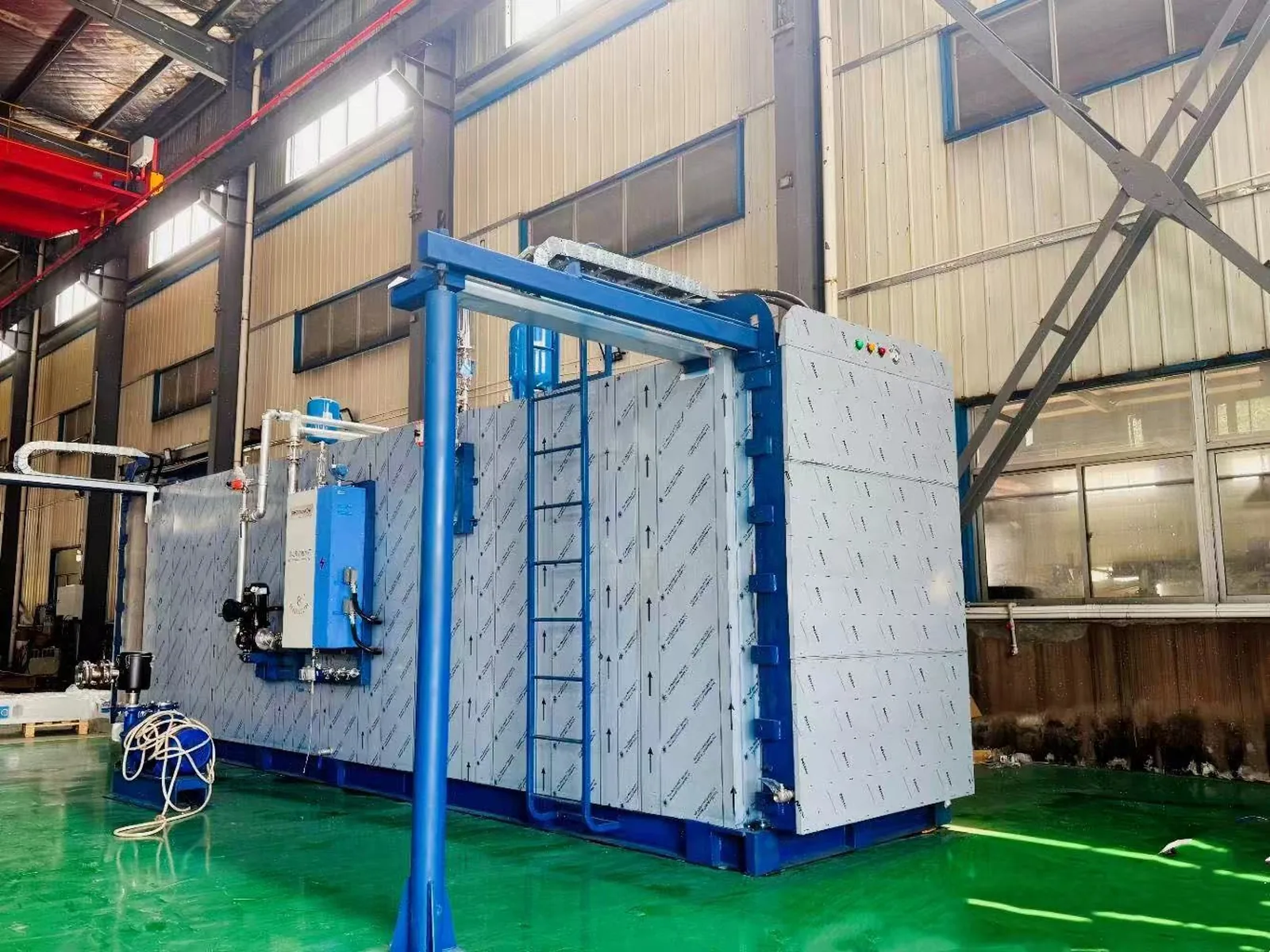
يتحكم, سلامة البيانات, and Qualification
The control system is where chamber size becomes a documentation problem. A 110 m³ vessel generates more sensor channels, longer cycle records, and a larger batch report than a 3 m³ unit, and the audit trail must remain readable at both ends of the range. BOCON’s self-developed controller logs the full cycle and prints the records that a validation file actually needs: process record, parameter conclusion, product list, detailed data report, and audit-trail operation log, with a server option for central archiving and remote support.
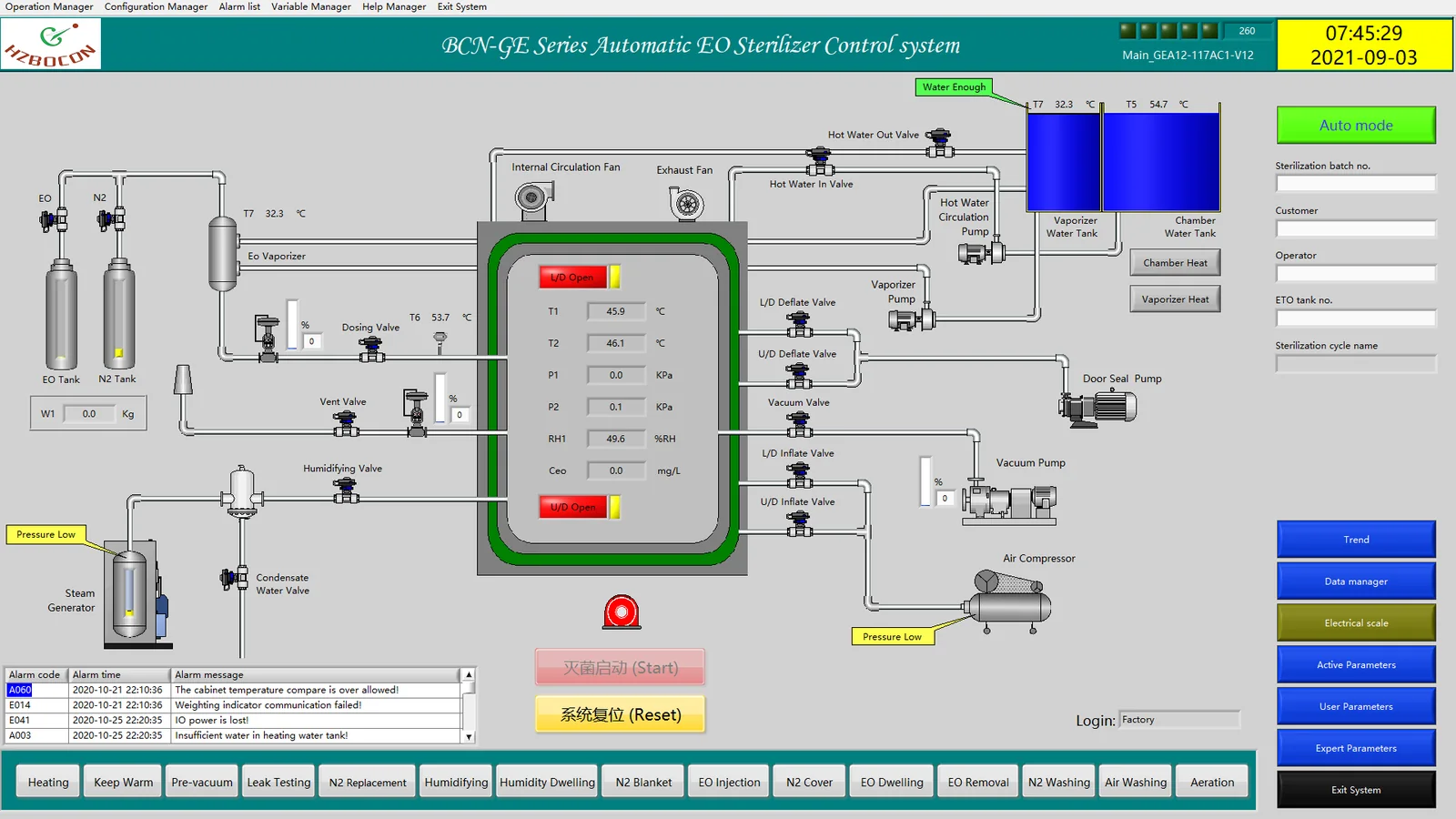
Before shipment, every chamber runs a factory acceptance test that includes positive and negative leak tests, vacuum and vent speed, humidification and heating rate, internal circulation, temperature and humidity uniformity, and a complete cycle. Installation is followed by IQ, أوكيو, and software validation with operator training, so the same dimensional data that drives the layout also drives the qualification protocol.
Site Readiness Checklist
- Floor: point loads from a loaded 110 m³ chamber and its pallet rails, not just the empty vessel weight.
- Access: the largest single component must pass the building opening — chamber length frequently exceeds 17 m.
- Height: lifting doors need up to 5.07 m; sliding doors need rail and header space above the opening.
- المرافق: بخار, compressed air, nitrogen, cooling water, and drainage sized to the cycle, not to the chamber volume alone.
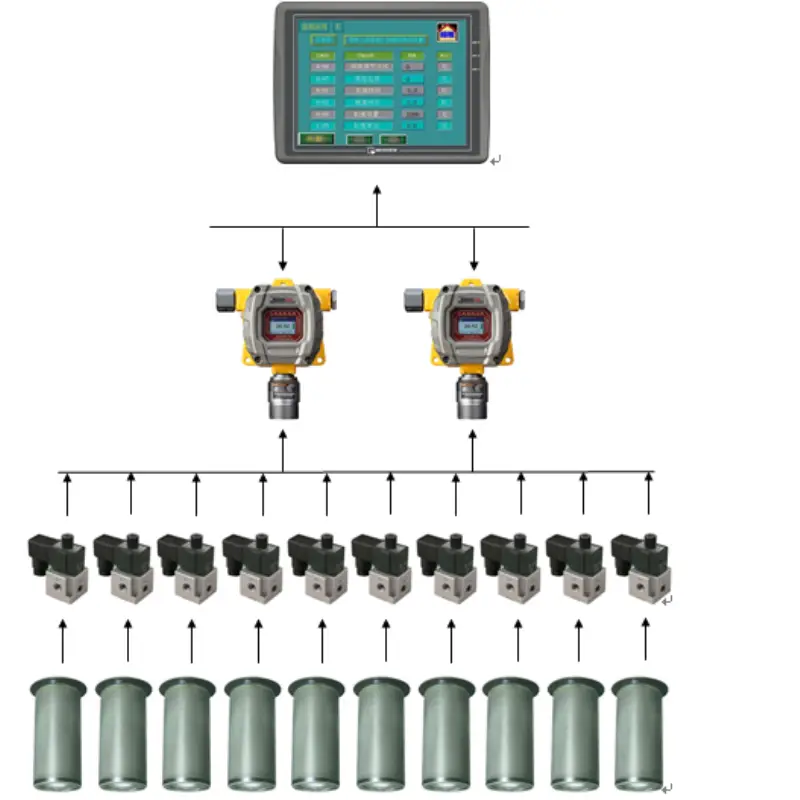
- Hazardous area: Ex zoning around the door, gas supply, and exhaust, with gas detection interlocked to ventilation.
- Clearance: at least 1 m for service access on the non-door sides, plus door travel and conveyor envelopes.
Why Teams Specify BOCON
Hangzhou Bocon has manufactured industrial ETO sterilizer systems since 2006 and exports to 44 بلدان, with chamber capacities from 1 m³ to 110 m³. Manufacturing runs across two Jiashan sites — Luoxing for control cabinets, R&د, and offices, and Huimin for chamber body production — supported by a strategic partnership with Meikesi, whose workshop holds Grade D and ASME pressure-vessel manufacturing capability. The portfolio covers hot-air and hot-water heating systems, preconditioning and aeration rooms, الناقلات, EO scrubbers, EO recovery, and EG burners, with roughly 35 patents including three granted in the United States.
For buyers comparing suppliers on the same capacity, the differentiators are usually the ones that appear after the chamber is installed: whether the aeration room was sized with the sterilizer, whether the controller produces a validation-ready record set, and whether the supplier can support the line across time zones. Those are engineering decisions, and they are easier to make before the foundation is poured.
Frequently Asked Questions
What is the largest ETO sterilizer BOCON manufactures?
110 م³, a two-row chamber measuring 17050 × 2700 × 2400 mm internally and holding 32 pallets of 1200 × 1000 mm. Larger or non-standard envelopes are engineered on request.
How much floor space does a 30 m³ ETO sterilizer need?
About 37 m² for the chamber alone with a sliding door (11.52 × 3.22 m). Add at least 1 m of service clearance on the non-door sides, door travel, and the conveyor or transfer car envelope.
What ETO sterilizer sizes are available, and can they be customised?
From 1 m³ laboratory units to 110 m³ two-row chambers, with every size in between. Internal length, width, height, and door type are all configurable, and every listed size can be adjusted. Custom envelopes are common when an existing building fixes the available footprint or ceiling height.
Does chamber size change the validation scope?
نعم. Performance qualification is tied to the load configuration and the chamber’s thermal and humidity distribution, so a larger vessel needs more sensor locations and a re-run of uniformity tests. Changing the maximum load after PQ normally requires revalidation.
Which door type suits an automated production line?
A sliding door, paired with a conveyor or transfer car. It presents a flat interface to the line and allows pallets to move directly between preconditioning, تعقيم, and aeration without manual handling.
Need a Chamber Size That Fits Your Building and Your Batch?
Send your pallet dimensions, daily throughput, and available floor plan. Our engineers return a chamber recommendation, external envelope drawing, and utility matrix within two business days.
Chat with an Engineer on WhatsApp Request a Technical Proposalمرجع: ايزو 11135:2014 · ISO 10993-7:2008 · ATEX 2014/34/EU. Dimensions are representative and confirmed on the approved drawing for each order.