
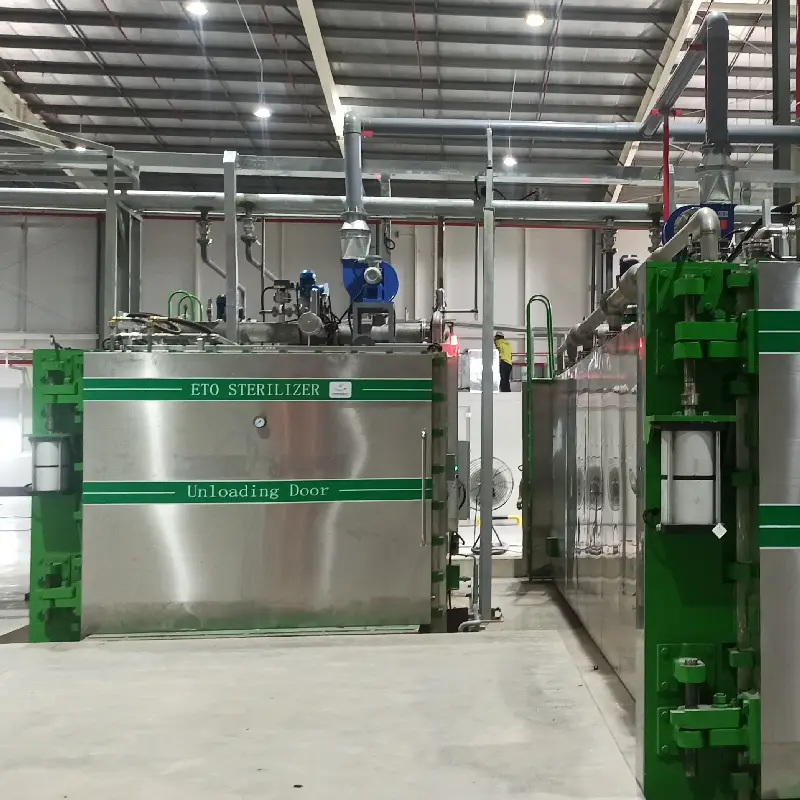
环氧乙烷灭菌: Comprehensive Safety Factors
Safety is the most critical pillar of 环氧乙烷 (环氧乙烷) 消毒. Because EO is a highly effective yet hazardous gas, a professional sterilization facility must prioritize a three-dimensional safety framework encompassing patients, workers, and the environment.
Patient Safety
- Residual EO Control: Ensuring products undergo rigorous aeration post-sterilization. Advanced degassing cycles are mandatory to bring residuals well below 国际标准化组织 10993-7 limits.
- Material Integrity: Validating that EO does not degrade medical device materials, ensuring the product remains safe and functional for clinical use.
Worker Safety
- Real-time Monitoring: Continuous gas detection in the workplace to alert staff of even trace EO levels.
- PPE Protocol: Strictly enforcing the use of specialized Personal Protective Equipment (PPE), including chemical-resistant gloves and masks during maintenance or gas cylinder handling.
Environmental Safety
- Abatement Systems: Deploying high-efficiency scrubbers or catalytic oxidizers to neutralize EO gas before atmospheric release.
- Regulatory Compliance: Adhering to local and federal EPA/Environmental laws regarding gas emissions and industrial waste.
⚠️
Safety Tip: An effective EO sterilization cycle is only half the battle. The true measure of a professional system is its ability to protect the operator and the surroundings through automated Nitrogen washes and leak-proof vessel design.
Safety Engineering at BOCON
博康的 BCS系列环氧乙烷灭菌器 are built with a “Safety-First” philosophy. Our equipment features dual-redundant safety interlocks, automated gas monitoring interfaces, and advanced EO abatement technology. By addressing these safety factors at the engineering level, we help medical device manufacturers achieve SAL 10⁻⁶ while prioritizing the well-being of their staff and the global environment.