Significance of Ethylene Oxide Residue Detection
Ethylene oxide (EO/EtO) is a powerful alkylating agent used to achieve total sterility in medical devices. However, its high toxicity and potential carcinogenicity necessitate precise EO residue detection. For manufacturers, verifying that residual levels meet safety thresholds is not just a regulatory hurdle—it is a critical patient safety mandate.
Regulated Products Requiring EO Testing
All disposable medical products sterilized via EO gas must undergo headspace gas chromatography analysis. Key products include:
Standard Compliance
BOCON equipment and validation protocols align with the industry’s most rigorous execution standards:
- GB/T 14233.1: Chemical analysis methods for infusion and injection equipment.
- GB/T 16886.7 (ISO 10993-7): Biological evaluation of medical devices – Ethylene oxide sterilization residuals.
Technical Methodology: Gas Chromatography (GC)
The Gas Chromatograph is the standard apparatus for measuring EtO residuals. By using water as an extractant, the EO content is determined through high-precision gas-liquid equilibrium.
Using Headspace Gas Chromatography, EO is extracted from the sample. Once the standard solution reaches equilibrium, the gas concentration is measured by recording the peak height or area on the chromatogram.
Weighing Method: 50mL of water is injected with ~6mL of EO gas. The exact weight is determined to $0.100g$ precision and diluted to $1 \times 10^{-2}g/L$ to create the master standard stock solution.
Optimizing Cycles to Reduce Detection Failure
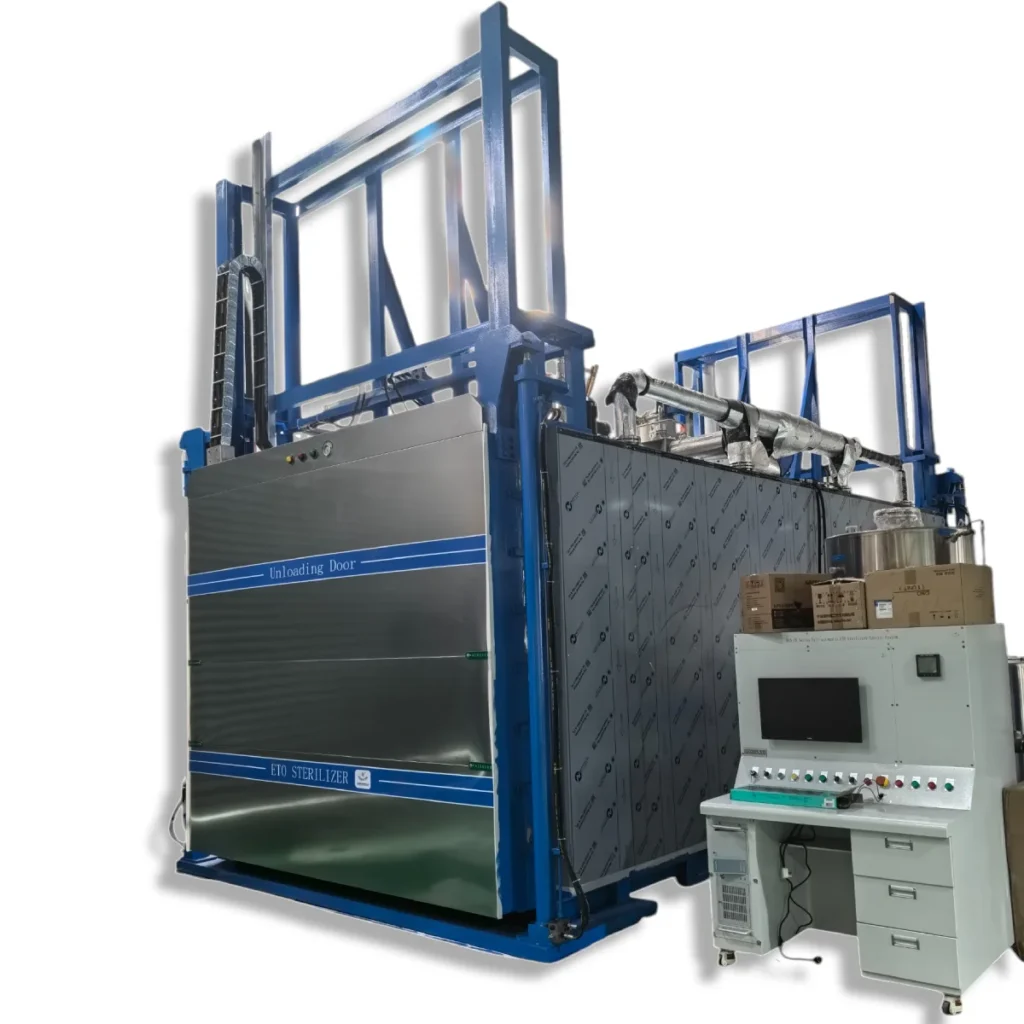
While detection is mandatory, preventing high residuals at the source is more efficient. BOCON’s BCS Series ETO Sterilizers feature optimized vacuum purging and heated aeration phases. By reducing Ethylene Oxide residuals during the sterilization cycle itself, we help manufacturers pass GC testing more consistently and accelerate product release to the market.